Kort fortalt
- 1,856recently divorced Danish participants
- Women > Menwomen reported significantly higher divorce-burnout scores (small effect)
- Sick daysburnout predicted sick days & work absence beyond depression
Study at a glance
- Study type: Cross-sectional baseline survey
- Country & period: Denmark, 2016–2018
- Time since divorce: ~5 days on average
- Sample size: N = 1,856
- Women: 66.8% of sample
- Outcomes measured: Vitality, coping, disengagement; sick days; work absence
What does this study examine?
Burnout is usually thought of as a workplace phenomenon, but recent research proposes it can arise from any prolonged, emotionally demanding situation. Divorce is a prime candidate: intense emotional strain, loss of social support, ongoing co-parenting demands and chronic uncertainty.
The central question: what is “divorce burnout” and who is most at risk? The paper introduces the concept and proposes the Divorce Burnout Model (DBM) — a gradual process of three interconnected experiences: reduced vitality (exhaustion, fatigue), reduced coping ability (feeling unable to manage daily demands) and disengagement (emotional problems interfering with work and daily life). It tests whether these form a coherent construct, who is most at risk, and whether burnout predicts real-world outcomes (sick days and work absence in the three months after divorce).
The Divorce Burnout Model (DBM)
The three facets — vitality, coping ability and disengagement — are adapted from the established burnout literature and were statistically validated here (confirmatory factor analysis, good fit, full measurement equivalence across men and women).
Depression and burnout overlap but are not identical: depression was treated as a control variable, and burnout predicted sick days and work absence even after depression was accounted for — capturing something distinct and practically important. SES ONE directly targets two of the three dimensions: it builds coping ability (tools, psychoeducation, exercises) and addresses disengagement by helping people manage emotions and reconnect with daily life.
Key findings
- The Divorce Burnout Model fits the data well, with full measurement equivalence across men and women.
- Women scored higher on burnout than men, though the difference was small (Cohen’s d = 0.13), consistent with women’s generally higher vulnerability to post-divorce emotional exhaustion.
- The strongest predictors were conflict and not having a new partner — along with the former spouse initiating the divorce. Being on the receiving end, with no new emotional support, appears particularly depleting.
- Additional predictors differed by gender: for men, fewer previous divorces; for women, lower income.
- Burnout predicted sick days and work absence beyond depression — even after controlling for sociodemographics, divorce characteristics and depressive symptoms.
What does this mean in practice?
Burnout is a meaningful, measurable experience for recently divorced people — distinct from, though related to, depression. That it predicts sick days and work absence matters for public health: the costs of divorce are not just personal but show up in absenteeism, healthcare use and lost productivity.
The predictors point to who is most at risk: people whose former spouse initiated the divorce, who have no new partner, who face high conflict, and — for women — those with limited financial resources. Two of the strongest predictors (conflict and poor communication) are areas SES ONE directly addresses, reinforcing that such interventions may reduce not just distress but the burnout-related productivity losses with broader societal costs.
Study notes
- Design limitation: Cross-sectional baseline data — describes the situation at divorce but cannot establish causal direction.
- Sample characteristics: More female and more highly educated than the general divorce population; may generalise somewhat less well to less-educated or male-majority samples.
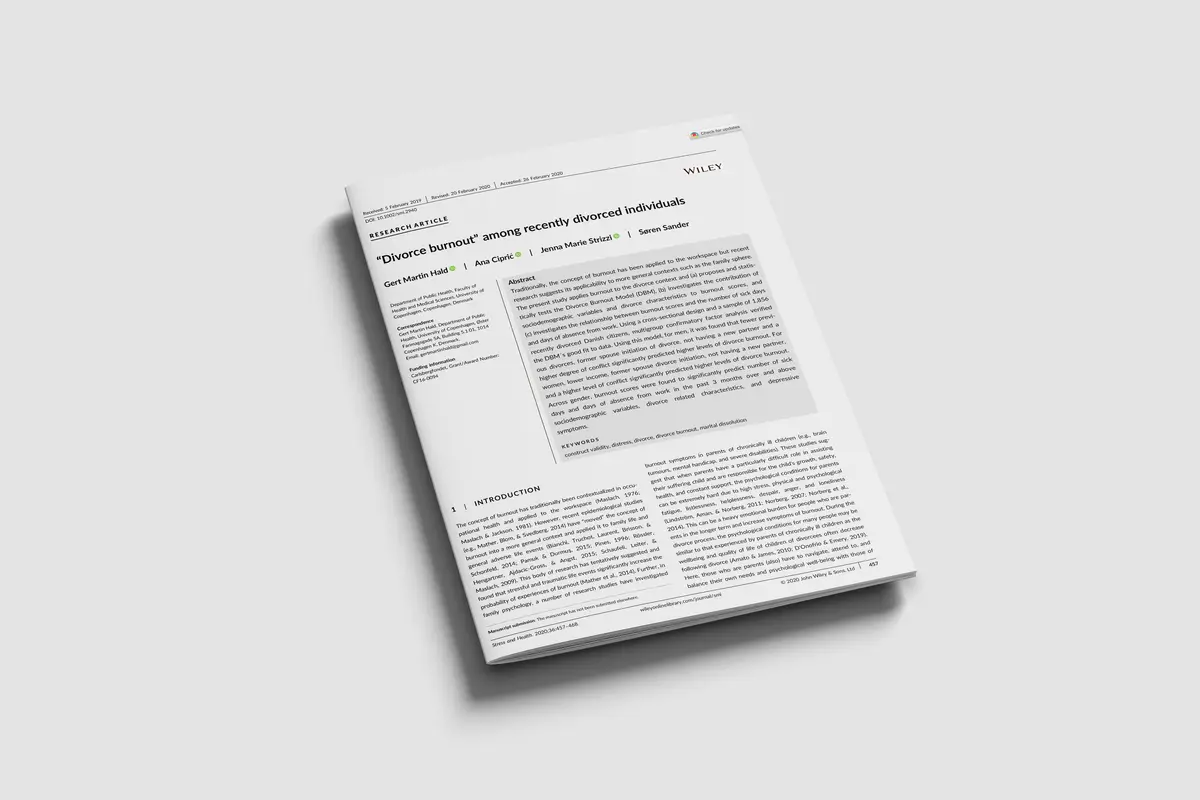
Hald, Cipric, Strizzi & Sander (2020). Stress and Health, 36, 457–468. DOI: 10.1002/smi.2940 · Funded by the Carlsberg Foundation (CF16-0094).