Kort fortalt
- 1,856recently divorced participants in the baseline survey
- 20%of men and women in the clinical range for hostility (vs 6–7% generally)
- d = 0.48–0.49moderate effect: divorcees vs general population on hostility
Study at a glance
- Study type: Baseline cross-sectional survey
- Country & period: Denmark, 2016–2018
- Time since divorce: ~5 days on average
- Comparison sample: N = 2,040 general Danish adults
- Women: 66.8% of sample
- Hostility measure: SCL-90-R subscale (validated)
What does this study examine?
Hostility is more than anger toward a former spouse. Here it is understood as a broader disposition — thoughts, feelings and actions tied to a negative affective state that can be directed at anyone: children, family, colleagues, friends. High general hostility is associated with poor coping, depression, cardiovascular risk and a greater likelihood of aggressive behaviour.
Most prior research focused only on hostility toward the former spouse. This study takes a broader view, comparing recently divorced Danes to a nationally representative norm sample and investigating which factors predict higher hostility — and whether they differ by gender. The central question: how hostile do recently divorced people feel, and what drives it?
Measuring hostility
General hostility was measured with the validated 6-item SCL-90-R subscale (temper outbursts, urges to harm others, frequent arguments). Participants were compared to a nationally representative sample of 2,040 adults. Predictors investigated included age, education, income, parental status, infidelity/violence as reasons for divorce, who initiated, new-partner status, degree of post-divorce conflict, communication quality and marriage duration.
Key findings
- Divorcees are substantially more hostile than the general population (women 0.67 vs 0.36; men 0.61 vs 0.31; d ≈ 0.48–0.49). About 20% scored in the clinical range, vs 6–7% generally.
- Men and women do not differ significantly in hostility levels (p = .062) — unlike partner-specific hostility, where women often score higher. Both carry a similar burden at this acute stage.
- Conflict and poor communication are the strongest predictors for both sexes — precisely the modifiable areas SES ONE targets.
- Infidelity, younger age and lower education also predict hostility (infidelity especially for women).
- The former spouse initiating the divorce raises hostility, as does neither party (or only the ex) having a new partner.
- The same factors predicted hostility equally in men and women (equality-constrained model, RMSEA = 0.013) — so gender-specific strategies are likely unnecessary.
What does this mean in practice?
Elevated hostility after divorce is not just a problem between former spouses — it affects children, colleagues and friends, undermines co-parenting and increases the likelihood of aggressive behaviour: a broader public-health concern.
The two strongest predictors, conflict and poor communication, are areas where structured intervention can help. SES ONE’s modules on co-parenting communication, dealing with conflict and managing anger directly target these mechanisms, giving theoretical grounding for why they should reduce not just conflict but the downstream hostility it generates. Since men and women share the same predictors, a single well-designed programme can serve both.
Study notes
- Cross-sectional design: Baseline data only — no causal conclusions; longitudinal tracking would clarify whether hostility declines over time and whether SES ONE accelerates that.
- Measure scope: General rather than partner-specific hostility — broader relevance, but less direct connection to ex-partner dynamics.
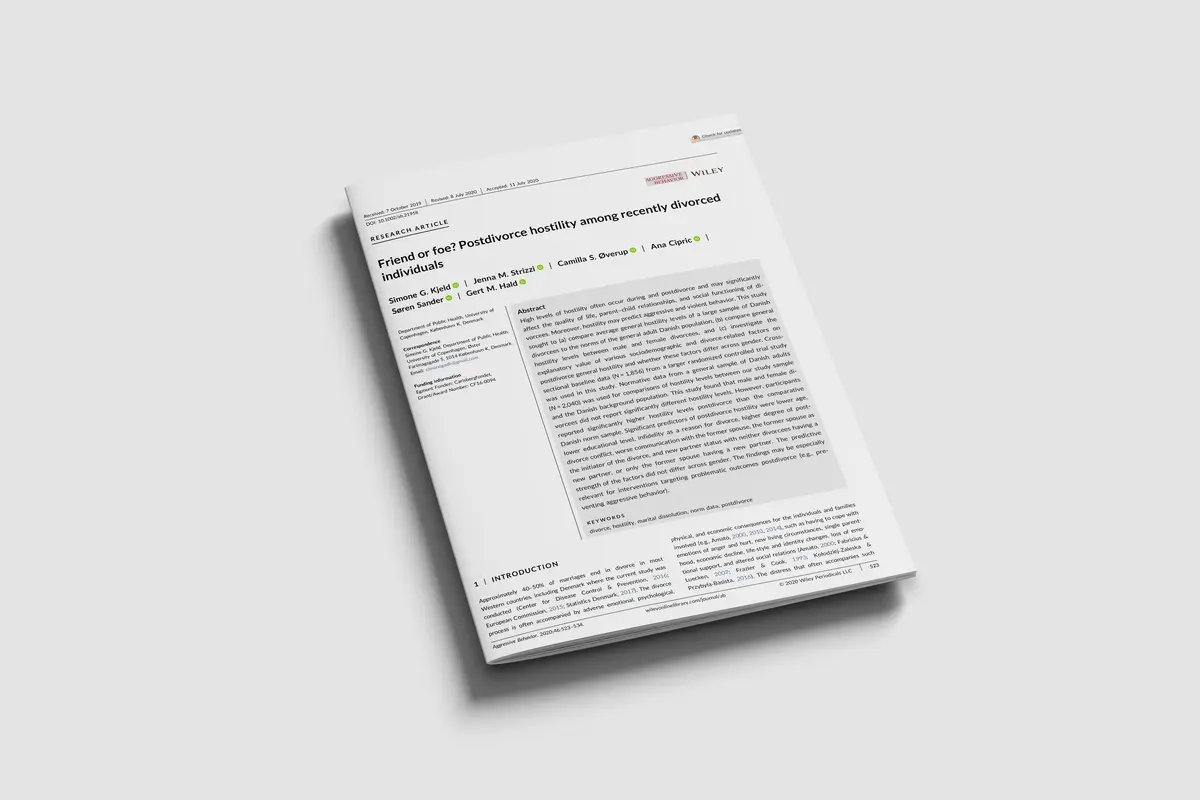
Kjeld, Strizzi, Øverup, Cipric, Sander & Hald (2020). Aggressive Behavior, 46, 523–534. DOI: 10.1002/ab.21918 · Funded by the Carlsberg Foundation (CF16-0094) & Egmont Foundation.