Kort fortalt
- 1,856recently divorced participants
- 80%of divorcees report some conflict with their former spouse
- Equalprogramme benefit across all conflict levels tested
Study at a glance
- Study type: Secondary RCT analysis
- Country & period: Denmark, 2016–2018
- Time since divorce: ~5 days on average
- Programme group: n = 1,031
- No-support control: n = 825
- Follow-up points: Baseline, 3, 6 & 12 months
What does this study examine?
Divorce conflict is one of the most powerful predictors of poor outcomes for everyone involved. Up to 80% of divorcees report some conflict with their former spouse, and high-conflict cases occupy a disproportionate share of family-court resources. For the adults involved, conflict is strongly linked to depression, anxiety, hostility and poorer physical health.
A widely held concern among practitioners is that digital self-help may not be enough for people in high-conflict divorces — that these situations need a more intensive, face-to-face approach. The central question: does the effectiveness of SES ONE vary depending on how much conflict a person is experiencing?
What is SES ONE (CAD)?
Conflict was assessed using the validated six-item Divorce Conflict Scale (DCS), capturing areas of disagreement (finances, child-rearing), how disagreements are managed (communication style) and overall hostility and mistrust. Four statistical models were compared for each outcome (no conflict effect; main effect; conflict-moderated trajectories; conflict-moderated intervention effects), with likelihood-ratio tests selecting the best fit.
High-conflict divorce is characterised by pervasive negative exchanges and a hostile, insecure emotional environment — not simply disagreement on practical matters. If digital programmes only worked for low-conflict divorces, they would need to be restricted or supplemented for a large share of divorcing people. This study tests that assumption for the first time using RCT data.
Key findings
- Higher conflict predicted worse health — but not a weaker programme response. Higher conflict meant more depression and poorer mental and physical health across the year, but the effectiveness of SES ONE did not vary by conflict level: equivalent benefit for low-, medium- and high-conflict divorces alike.
- High-conflict divorcees showed the steepest improvements in stress, anxiety and hostility over 12 months — partly more room to improve from a higher start, partly the natural easing of acute stress as day-to-day contact decreases.
- Depression and overall health were more persistently linked to conflict. Higher conflict continued to predict higher depression and poorer health throughout the year — outcomes that need more sustained attention than reduced contact alone provides.
- The programme likely works across conflict levels by building coping capacity — it supplements a person’s own resources rather than requiring a conflict-free environment, and the private digital format may reduce defensiveness and improve engagement.
What does this mean in practice?
The concern that online divorce support suits only low-conflict cases is not supported. SES ONE is equally effective across the full range of conflict levels, so there is no basis for excluding high-conflict individuals from digital programmes. One universally offered programme can reach a large population at low cost and still produce meaningful benefits.
People in high-conflict divorces nevertheless remain at elevated risk of depression and poorer health even after 12 months. For this group a “blended” approach — combining the digital programme with professional support such as mediation or counselling — may add benefit. The programme works as a foundation and complement to in-person services, not only as a stand-alone solution.
Study notes
- Conflict measured at baseline only: It is not possible to tell whether changes in conflict over the year mediated changes in health; future research measuring conflict at multiple points would give a fuller picture.
- Representativeness: Representative in age, income and marriage duration, but more women and more highly educated participants; only minor attrition bias, with all available data used.
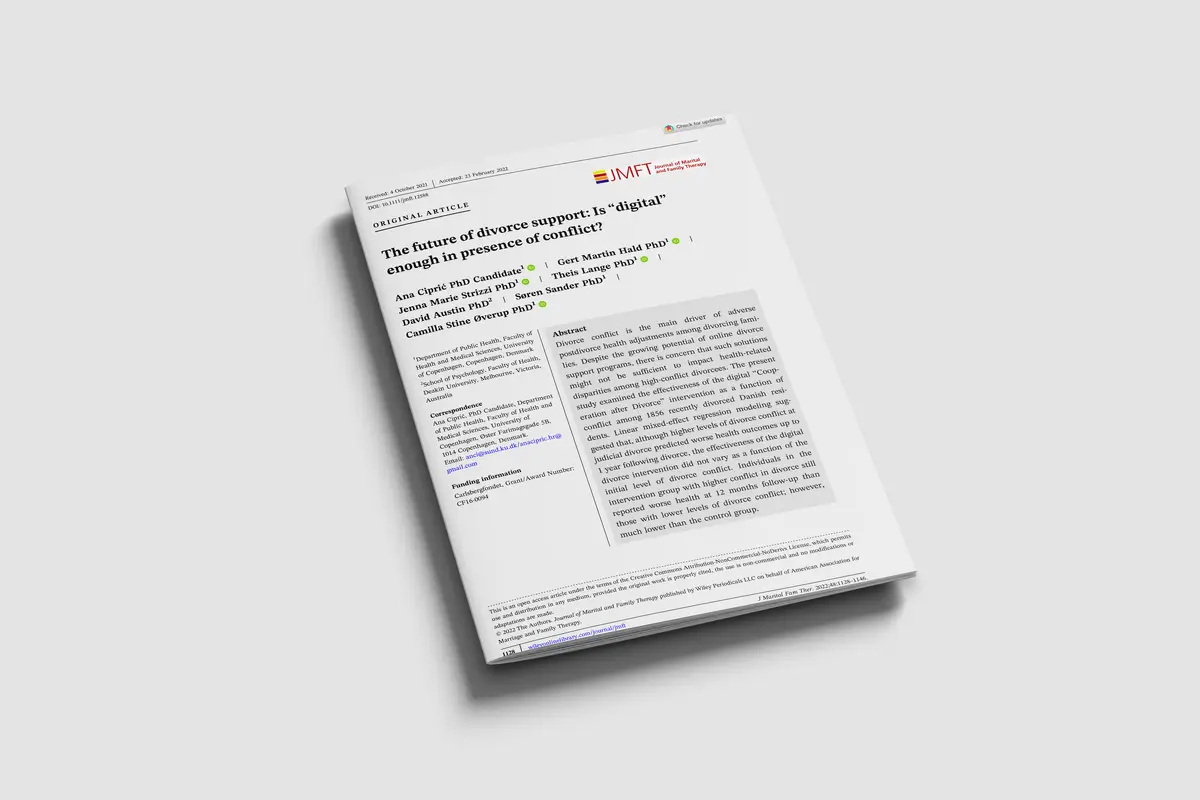
Ciprić, Hald, Strizzi, Lange, Austin, Sander & Øverup (2022). Journal of Marital and Family Therapy, 48, 1128–1146. DOI: 10.1111/jmft.12588 · Open access (CC BY-NC-ND) · Funded by the Carlsberg Foundation Distinguished Associate Professor Fellowship (CF16-0094).