Kort fortalt
- 1,856participants tracked for 5 years (income & employment registers)
- 5.21% highercumulative labour-market income over 5 years vs controls
- 22% fewersick-leave weeks among those who took any long-term leave (4.41 weeks)
Study at a glance
- Study type: 5-year post-trial observational follow-up of an RCT
- Country: Denmark
- Original RCT period: 2016–2018
- Programme group: n = 1,031
- No-support control: n = 825
- Follow-up length: 5 years post-divorce, using national register data
What does this study examine?
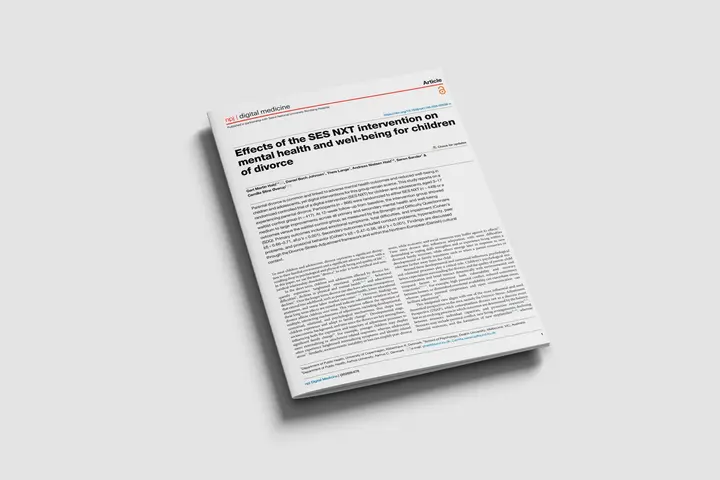
Divorce has well-documented consequences for working life and finances: divorcees are more likely to take extended sick leave, rely on welfare, experience unemployment and see incomes fall — effects that can persist for years. Yet we know little about whether improving someone’s mental health after divorce also improves their long-term social functioning.
The central question: can a digital mental-health intervention at the point of divorce produce measurable improvements in work and income years later? Using objective Danish national register data — actual benefits claimed and income earned — the researchers tracked the full original RCT cohort across four social and economic outcomes. This is among the first studies to link a digital divorce intervention with objective long-term social outcomes.
What is SES ONE (CAD)?
SES ONE is a free, self-paced online programme with 17 modules of 15–50 minutes each, covering the divorcee, the children and co-parenting, integrating CBT, Narrative Therapy and ACT. It is freely available in Denmark, Iceland, Finland and Sweden. The chosen outcomes — sick leave, welfare use, unemployment and income — can be converted into monetary figures, giving policymakers a concrete way to assess the economic value of support at the point of divorce.
Key findings
- Higher labour-market income across all 5 years. SES ONE participants accumulated 5.21% more income; while the overall difference did not reach the preregistered significance threshold, it was consistently positive and reached significance in year 3 (7% more, p = .05).
- Significantly fewer sick-leave weeks for those who took any leave — 15.48 vs 19.89 weeks (a 22% / 4.41-week reduction; p = .02). A “reduce, not remove” effect: those who took leave recovered and returned to work sooner.
- Fewer weeks on welfare and lower unemployment. 2.51 fewer welfare weeks over five years (a 7% reduction, not statistically significant); unemployment slightly lower across all years (Denmark’s very low unemployment limited statistical power).
- Consistent positive trends, mixed statistical significance. Cumulative estimates all pointed toward better outcomes for the programme group but did not all reach preregistered thresholds — the effects may be real but modest, or may need longer follow-up to fully emerge.
What does this mean in practice?
The social and economic costs of divorce extend far beyond the emotional — extended sick leave, welfare reliance and lost income are real costs to individuals, families and public finances. This study suggests offering SES ONE at the point of divorce may help reduce these costs, even if effects are modest or take time to accumulate.
Importantly, Denmark has one of the world’s strongest social safety nets; positive trends here suggest effects in countries with weaker support systems would likely be even stronger. The findings also suggest digital support works best as a complement to — not a replacement for — existing services, integrated with primary care, municipal family services or employment counselling.
Study notes
- Representativeness: Participants were more likely to be women, highly educated and first-time divorcees; effects in less-educated or lower-income groups may differ, and Denmark’s strong welfare system may dampen measured effects.
- Statistical significance: Several trends were in the expected direction without reaching preregistered thresholds — possibly modest effects, a welfare-system ceiling, or too short a follow-up for income/employment effects to fully appear.
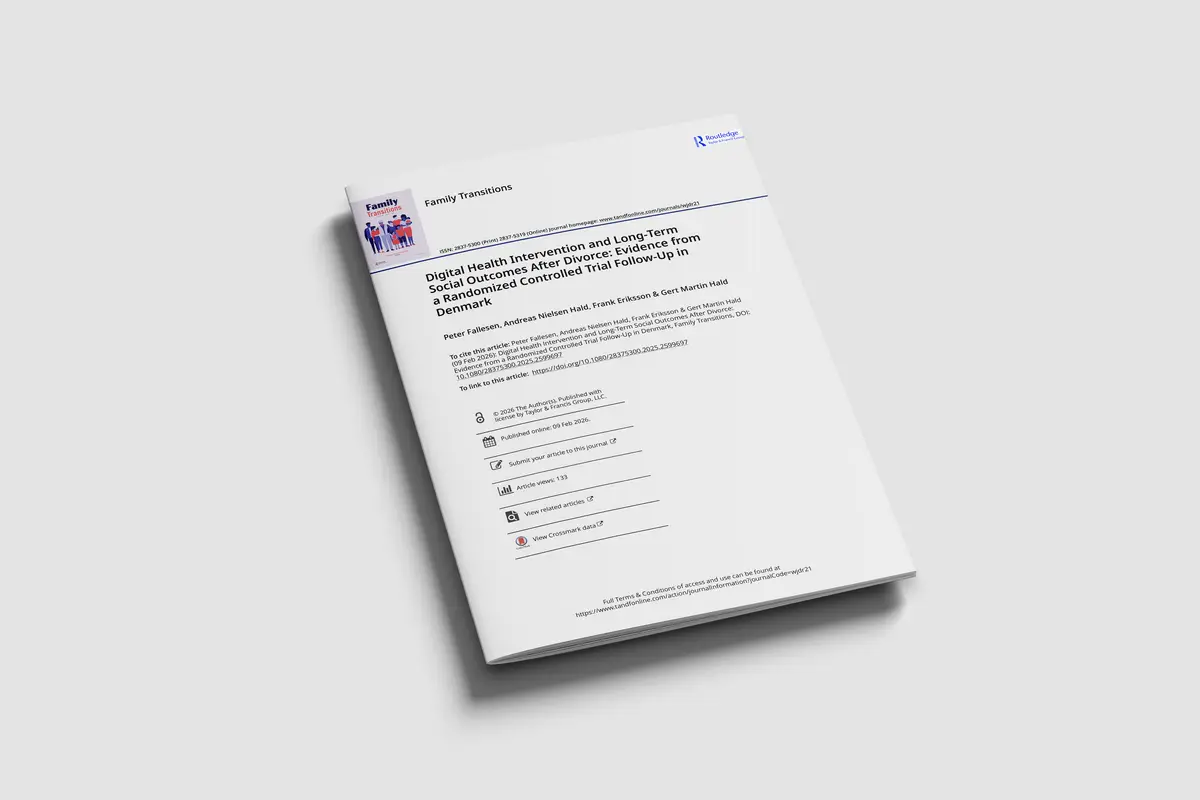
Fallesen P, Hald AN, Eriksson F & Hald GM (2026). Family Transitions. DOI: 10.1080/28375300.2025.2599697 · Open access (CC BY) · Funded by the ROCKWOOL Foundation (grant 1263) and the Carlsberg Foundation Distinguished Associate Professor Fellowship (CF16-0094).