Kort fortalt
- 1,856recently divorced Danish participants
- d = 0.78–1.75adjusted effect sizes for depression reduction at each follow-up
- 5–15% vs 26–42%in the at-risk range at 12 months (programme vs untreated control)
Study at a glance
- Study type: Randomized Controlled Trial (RCT)
- Country & period: Denmark, 2016–2018
- Time since divorce: ~5 days on average
- Programme group: n = 1,031
- No-support control: n = 825
- Follow-up points: Baseline, 3, 6 & 12 months
What does this study examine?
Divorce is consistently linked to elevated rates of depression, anxiety and somatization (physical symptoms with a psychological component, such as headaches or fatigue). These three conditions often occur together and can seriously affect a person’s functioning, quality of life and ability to parent effectively.
The central question: how does SES ONE affect depression, anxiety and physical symptoms after divorce?
This was the first large-scale, longitudinal RCT to evaluate whether an online divorce support programme could reduce all three outcomes simultaneously. Participants completed their baseline survey on average just 4.74 days after receiving their legal divorce decree — one of the only studies to capture the acute phase of divorce before any significant time-healing effect could occur. Because most participants had little or no separation before their legal divorce, the study gives a uniquely clear picture of how bad things get immediately after divorce, and whether SES ONE can change that trajectory.
What is SES ONE (CAD)?
SES ONE is a free, self-paced online programme with 17 learning modules of 30–60 minutes each, accessible from any device. Participants chose which modules to use and when, averaging 4.27 modules over the year. It covers three core areas — yourself (grief, anger, negative thoughts, personal crisis), your children (how children experience divorce and how to communicate with them) and co-parenting (communication, agreements, conflict reduction, common ground).
Participants were randomly assigned by the system to receive access to SES ONE or no additional support, and were measured with validated, nationally normed clinical instruments at four time points.
Key findings
- Large reductions in depression, anxiety and physical symptoms. At 3, 6 and 12 months, SES ONE users reported substantially lower levels of all three outcomes than the no-support group. Effect sizes were large across outcomes and time points (Cohen’s d = 0.78 to 1.75 for depression in adjusted analyses) and remained robust after controlling for dropout.
- The biggest gains came in the first 3 months — when people are most distressed and most responsive to help. The programme appears to work at exactly the right moment.
- Programme participants returned to near-normal population levels. At 12 months, 42% of men and 32% of women in the control group were still in the clinical range for depression, compared to 13% and 10% in the SES ONE group.
- Time helps, but not enough on its own. The control group also improved, but much more slowly, and after a full year remained well above national norms on all three outcomes.
- The programme worked equally well for men and women. Women reported somewhat higher baseline distress, but the rate of improvement was statistically equivalent across gender.
What does this mean in practice?
Divorce is one of the most common causes of depression and anxiety that does not automatically come with mental-health support. Most people going through divorce receive no structured psychological help, even when their symptom levels would meet clinical thresholds for treatment.
SES ONE provides that structure in an accessible, on-demand format — meeting people where they are, at the exact moments of distress or confusion they experience. Bringing symptom levels down to near general-population norms within 12 months is a clinically meaningful improvement, and it exceeded the effectiveness previously observed in face-to-face, court-affiliated divorce education programmes. Offered at scale and low cost, this represents a significant public-health opportunity.
Study notes
- Sample characteristics: Representative of Danish divorcees in age, income and marriage duration, but with more women and more highly educated participants — interpret with some caution when generalising to less-educated groups.
- Attrition: Dropout was high (typical of online studies); only younger age and poorer physical health predicted it. All analyses were intention-to-treat using all available data, and controlling for dropout actually strengthened the intervention effects.
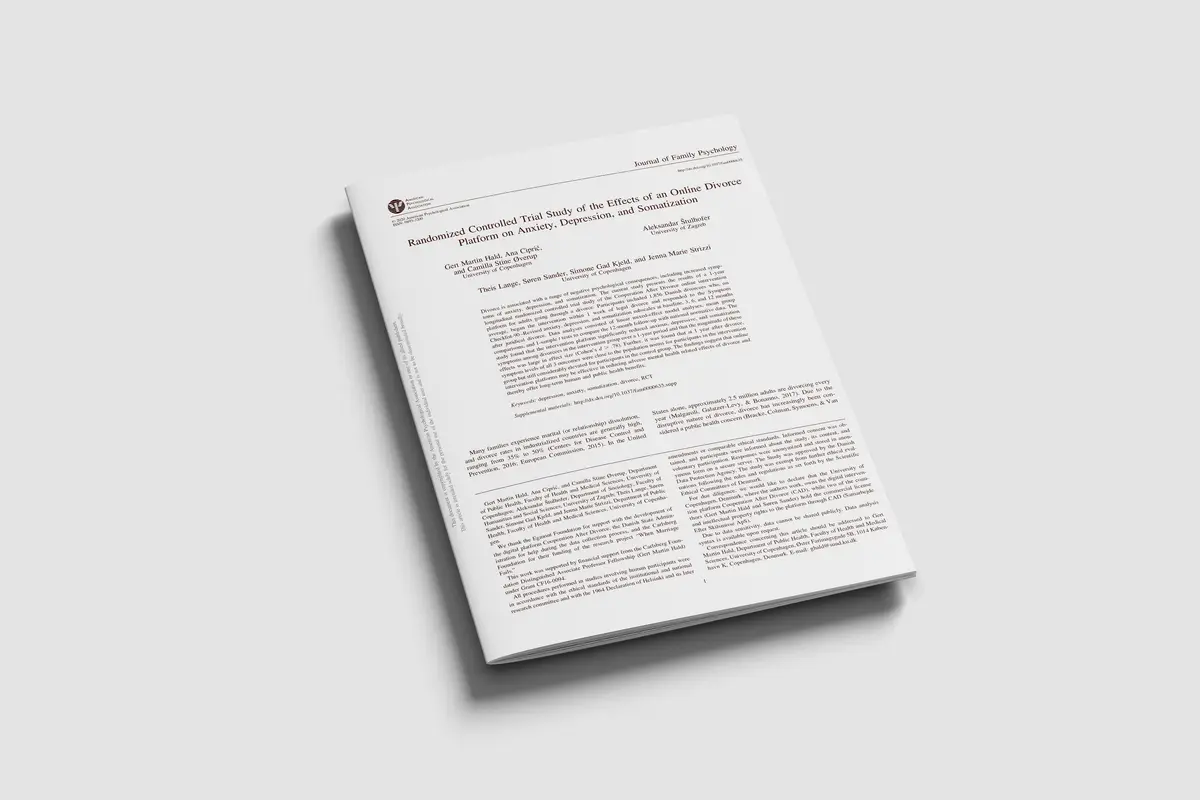
Hald, Ciprić, Øverup, Štulhofer, Lange, Sander, Gad Kjeld & Strizzi (2020). Journal of Family Psychology (Online First, 20 February 2020). DOI: 10.1037/fam0000635 · Funded by the Carlsberg Foundation Distinguished Associate Professor Fellowship (CF16-0094).