Kort fortalt
- 1,856recently divorced participants
- 24% vs 8%of control vs SES ONE men with problematic hostility at 12 months
- d = 0.43–0.59effect size for hostility reduction at each follow-up (unadjusted)
Study at a glance
- Study type: Randomized Controlled Trial (RCT)
- Country & period: Denmark, 2016–2018
- Time since divorce: ~5 days on average
- Programme group: n = 1,031
- No-support control: n = 825
- Follow-up points: Baseline, 3, 6 & 12 months
What does this study examine?
Divorce is among the most stressful life events a person can experience, and for many it is accompanied by elevated hostility: annoyance and irritation, a desire to harm others, and hostile actions such as shouting or throwing things. This hostility can spill over from the ex-partner relationship into other areas of life — affecting children, family, friends and work.
The central question: can a digital programme reduce hostility after divorce, and does the effect last a full year?
Although hostility is a key component of psychological distress with well-documented consequences for co-parenting and relationships, it has rarely been the focus of divorce-intervention research. This is the first study to present longitudinal RCT results for an online intervention specifically examining general hostility among recently divorced individuals. It also examines whether trajectories differ by gender and how divorced Danes compare to population norms after one year.
What is SES ONE (CAD)?
SES ONE (Cooperation after Divorce, or CAD) is a free, self-paced online programme with 17 learning modules of 30–60 minutes each, accessible from any device (participants averaged 4.27 modules). It covers yourself, your children and co-parenting. Participants were recruited through the Danish State Administration and randomised into the programme group or a no-support control — the most rigorous way to test whether a programme actually works.
Key findings
- SES ONE significantly reduced hostility at every follow-up. The control group showed no significant change from baseline at any point, while the intervention group showed consistent reductions (Cohen’s d = 0.43 to 0.59, unadjusted), robust after controlling for attrition.
- After one year, the SES ONE group reached normal population levels of hostility. About 24% of control men and women scored above the cut-off for problematic hostility, vs just 8% of men and 12% of women in the SES ONE group.
- The benefit was equal for men and women. Women reported somewhat higher hostility at baseline, but the rate of improvement was statistically identical.
- The reduction may reflect broader gains in emotional wellbeing. It is consistent with the programme’s effects on stress, anxiety, depression and somatization — by addressing the emotional aspects of divorce, SES ONE likely reduced hostile reactions as a downstream effect, with implications for co-parenting quality and reduced risk of intimate-partner conflict.
What does this mean in practice?
Hostility after divorce does not just affect how a person feels — it affects children exposed to parental conflict, co-parenting quality, and working relationships and friendships. A programme that durably reduces hostility to population-normal levels within a year therefore has consequences well beyond the individual.
Without support, roughly one in four recently divorced people still experiences problematic hostility a full year on; with SES ONE, that falls to roughly one in twelve. An online platform made available immediately upon divorce filing could be a viable population-level strategy for reducing hostility and distress — and could complement face-to-face therapy by handling common post-divorce challenges so therapy time is freed for more personalised issues.
Study notes
- Representativeness: Representative in age, income and marriage duration, but with more women and more highly educated participants — may generalise somewhat less well to less-educated groups.
- Attrition: High dropout (common online), but no meaningful bias found; all available data used.
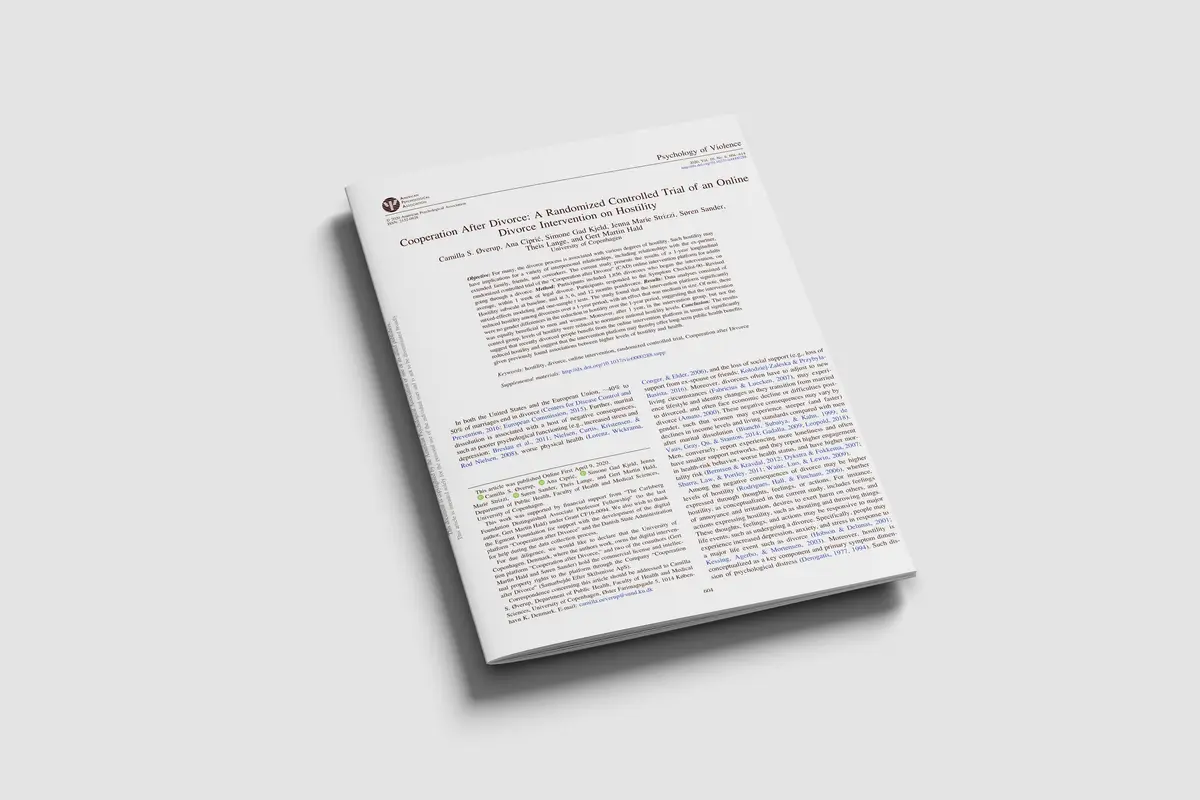
Øverup, Cipric, Gad Kjeld, Strizzi, Sander, Lange & Hald (2020). Psychology of Violence, 10(6), 604–614. DOI: 10.1037/vio0000288 · Funded by the Carlsberg Foundation Distinguished Associate Professor Fellowship (CF16-0094).