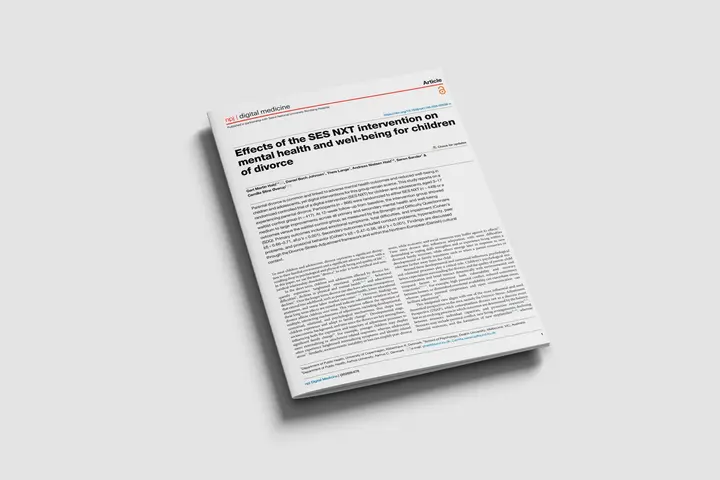
Kort fortalt
- 1,856recently divorced participants
- 24% vs 61%men still in high-stress range at 12 months (programme vs no support)
- d = 1.40–2.21adjusted effect size of stress reduction at each follow-up
Study at a glance
- Study type: Randomized Controlled Trial (RCT)
- Country & period: Denmark, 2016–2018
- Time since divorce: ~5 days on average
- Programme group: n = 1,031
- No-support control: n = 825
- Follow-up points: Baseline, 3, 6 & 12 months
What does this study examine?
Divorce is one of the most stressful life events a person can experience. The stress it causes is not just emotional: sustained high stress is linked to serious physical and mental health consequences, including depression, bodily illness, and reduced ability to cope with daily life. For many people, this stress does not fade quickly on its own.
The central question: can a digital programme reduce stress after divorce?
Participants completed their baseline questionnaire on average just 4.74 days after receiving their legal divorce decree — data collected at one of the most acute moments of the experience. At that point, 65% of men and 58% of women already scored in the clinically high-stress range.
This was the first large-scale longitudinal RCT to test whether an online programme could help recently divorced adults recover from that stress faster, and whether any benefit would still be detectable a full year later.
What is SES ONE (CAD)?
SES ONE (known in research as Cooperation after Divorce, or CAD) is a free, self-paced online programme accessible from any device. It contains 17 learning modules of 30–60 minutes each; participants chose which modules to use and when, averaging 4.27 modules during the study. It covers three core areas:
- Yourself: managing grief, anger, negative thoughts and personal crisis
- Your children: understanding how children experience divorce and communicating with them
- Co-parenting: communication, agreements, conflict reduction and finding common ground
Participants were recruited through the Danish State Administration and randomised into either the programme group or a no-support control group. A randomized controlled trial — where people are assigned by chance — is the most rigorous way to test whether a programme actually works, rather than simply attracting people who were already recovering.
Key findings
- The programme significantly accelerated stress recovery. At every follow-up — 3, 6 and 12 months — SES ONE users reported substantially lower stress than those with no support. Effect sizes were large (Cohen’s d = 1.40 to 2.21 in adjusted analyses): clinically meaningful, not marginal.
- After 12 months, the programme group reached normal stress levels — statistically indistinguishable from the national norm for divorced Danes. The no-support group remained significantly above those norms (61% of men and 56% of women still in the high-stress range, vs 24% of men and 31% of women in the programme group).
- Time alone helps, but not enough. The control group also improved over time, but after a full year had still not reached normal stress levels. SES ONE compressed the recovery timeline substantially.
- The benefit was equal for men and women. Women reported higher stress at the outset, but the rate of improvement from the programme was statistically the same for both.
What does this mean in practice?
Without support, high stress after divorce can persist for well over a year — and prolonged stress is associated with physical illness, impaired immune function, reduced work capacity and worse outcomes for children in the home.
SES ONE appears to work because it is available on demand (people can access content when they need it most rather than waiting for an appointment), it covers the specific challenges divorcees face, and it offers clear, practical guidance rather than general advice. Together these build coping capacity at a time when people’s own resources are most depleted.
Offering this kind of structured online support as a standard part of the divorce process could produce meaningful, lasting public-health benefits — at scale and low cost.
Study notes
- Representativeness: The sample matched Danish divorcees in age, income and marriage duration, but included more women and more highly educated participants, so results may generalise somewhat less well to less-educated groups.
- Attrition: Drop-out was high, as is common in online studies, but analyses found no meaningful bias — those who stayed were similar to those who left, and all available data were used in the statistical model.
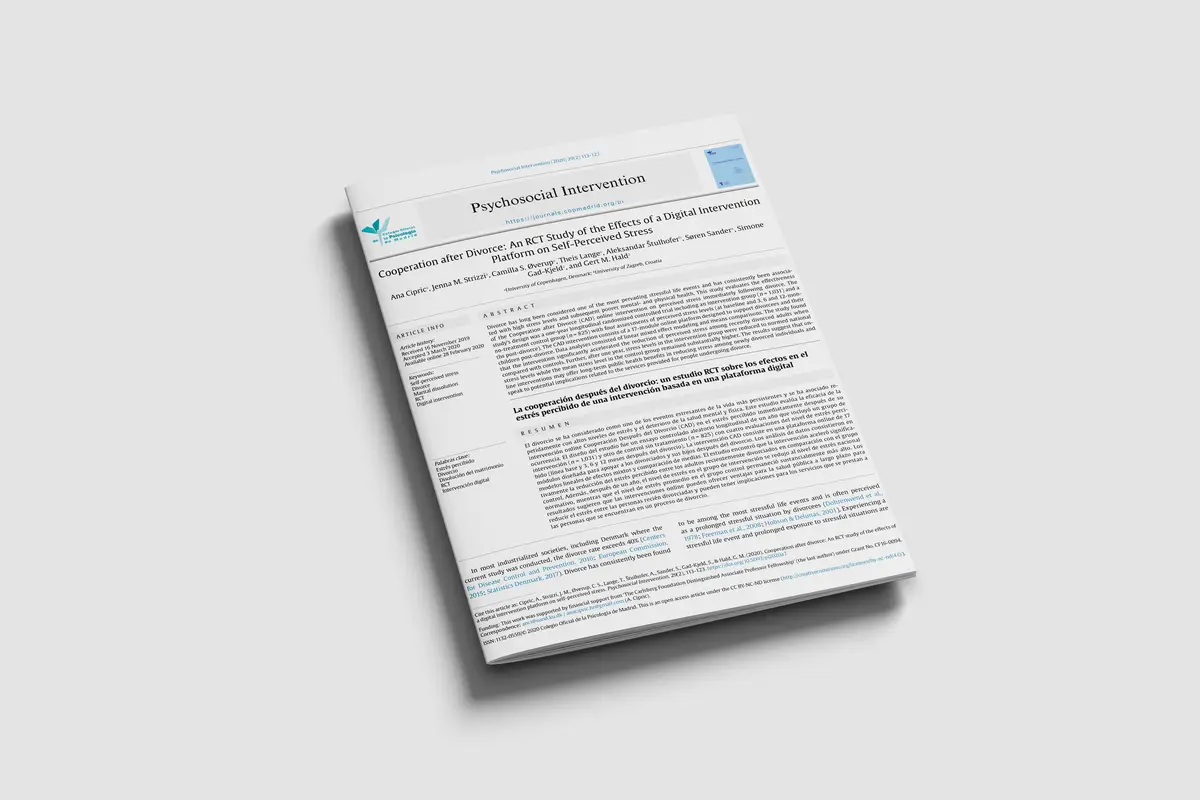
Cipric, Strizzi, Øverup, Lange, Štulhofer, Sander, Gad-Kjeld & Hald (2020). Psychosocial Intervention, 29(2), 113–123. DOI: 10.5093/pi2020a7 · Open access (CC BY-NC-ND) · Funded by the Carlsberg Foundation Distinguished Associate Professor Fellowship (CF16-0094).