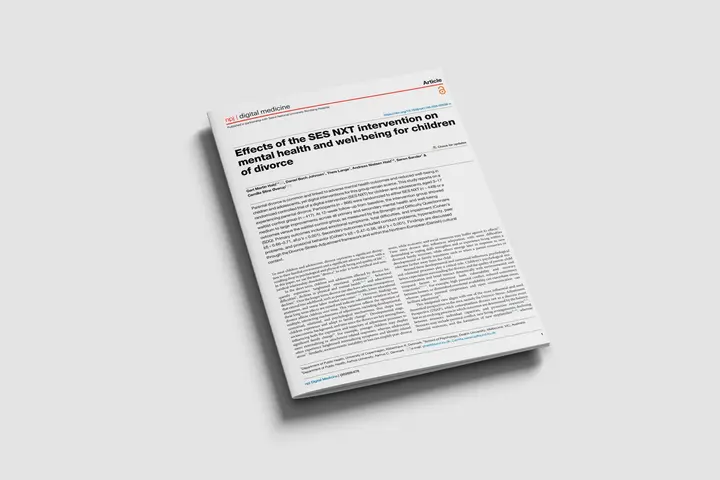
Kort fortalt
- Ages 3–17the full child age range covered, from pre-school to late adolescence
- ~700 familiestarget sample via municipalities and the Agency of Family Law
- 4 age groupscontent adapted to the cognitive, emotional and digital level of each stage
Study at a glance
- Study type: Randomized Controlled Trial (RCT) — study protocol
- Country: Denmark
- Target participants: Children aged 3–17 who have experienced parental relationship dissolution
- Intervention group: Immediate access to SES NXT
- Control group: Wait-list (access after 12 weeks)
- Follow-up points: Baseline, 4 weeks & 12 weeks post-baseline
What does this study examine?
In Denmark, around 22% of children live split between two households, and each year roughly 24,000 children experience their parents separating. Parental relationship dissolution is consistently associated with emotional difficulties, lower self-esteem, poorer peer relationships and symptoms of depression and anxiety — both short-term and years later.
While programmes exist to support adults going through divorce, relatively few focus directly on the children, and those that do are typically delivered in person, in therapist-led groups — expensive to run, hard to access and difficult to scale nationally. The central question: can a fully digital, age-adaptive intervention help children aged 3–17 cope better with parental separation? This is a protocol paper — it describes the planned, pre-registered study before results are available.
What is SES NXT?
SES NXT is a free, modular digital intervention using text, video, animation, voice-overs and interactive activities. Content areas:
- Emotions: understanding and accepting sadness, guilt, anger and longing
- Practical matters: living in two homes, packing bags, changeover days
- Agency: finding a trusted adult, setting limits, communicating needs
- Family: new family structures, bonus families, what divorce means
It is tailored across four developmental stages: 3–5 (short videos for parent and child to watch together, with conversation prompts), 6–8 (videos and simple text with limited reading required), 9–12 (interactive content with age-appropriate characters and exercises) and 13–17 (deeper reflective content with peer-age characters and more abstract concepts).
Key findings (planned outcomes)
- Primary outcomes: At 12 weeks, SES NXT children are expected to report significantly fewer emotional problems, a lower overall difficulty score and less impact of difficulties on daily life — all measured with the Strengths and Difficulties Questionnaire (SDQ).
- Secondary outcomes: conduct problems, hyperactivity, peer relationships, prosocial behaviour, quality of life and physical symptoms (headaches, stomach aches, sleep), plus the child’s ability to communicate needs, set limits, connect with a trusted adult and maintain school attendance.
- Why a pre-registered protocol matters: pre-registering before data collection is a scientific safeguard ensuring hypotheses and analysis cannot be changed after seeing the data. Results are published separately once analysis is complete.
What does this mean in practice?
Virtually no rigorous digital interventions exist specifically for children experiencing parental separation, and the closest examples cover only a narrow age range (11–16), leaving most affected children — particularly younger ones — without evidence-based digital support.
Children cannot choose their circumstances. An accessible, age-appropriate digital programme that normalises their feelings, builds coping skills and helps them communicate — available on any device, any time — can reach a population that in-person services consistently fail to serve. If the trial demonstrates effectiveness, it will provide the evidence base for integrating SES NXT into the standard resources offered to families at the point of separation, at scale and low cost.
Study notes
- This is a protocol paper — it describes the planned study, not its results.
- Limitations: the study cannot guarantee that children aged 11–17 complete surveys privately, and online recruitment may skew the sample toward more educated or proactively help-seeking families.
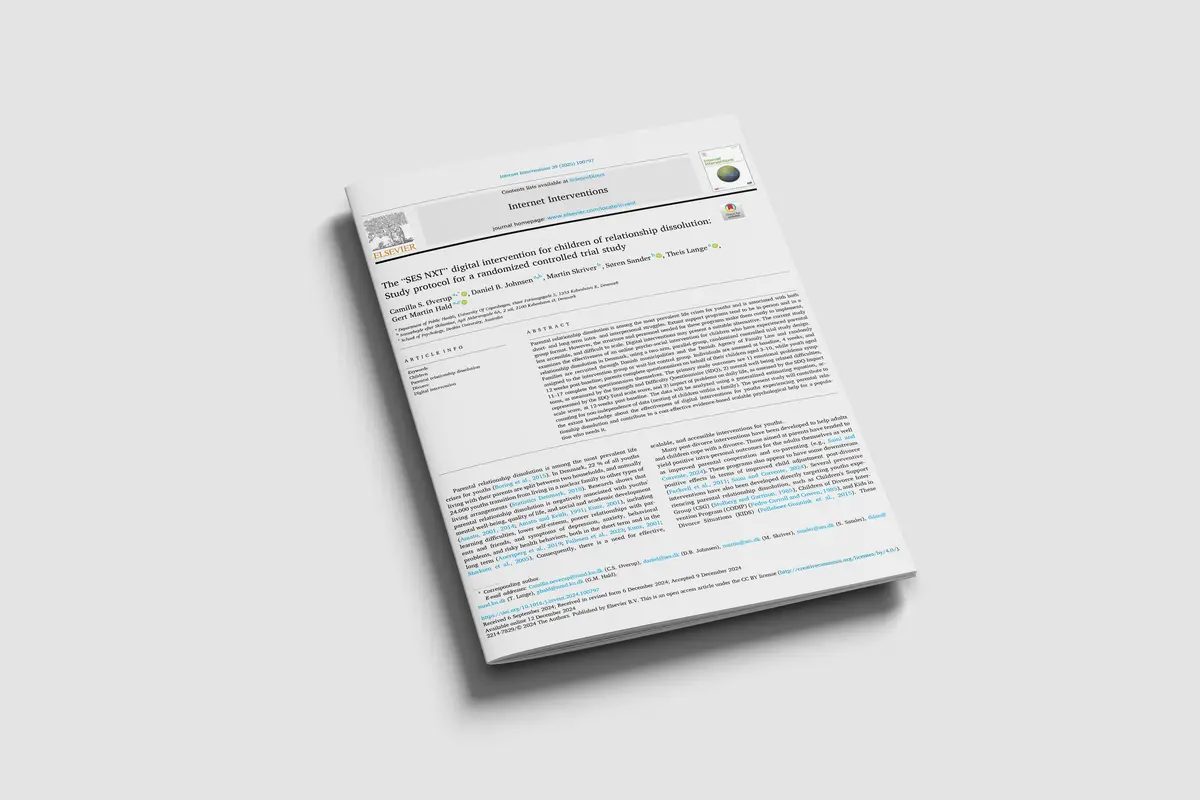
Øverup CS, Johnsen DB, Skriver M, Sander S, Lange T & Hald GM (2025). Internet Interventions, 39, 100797. DOI: 10.1016/j.invent.2024.100797 · Open access (CC BY) · Funded by Helsefonden (22-B-0105) and Innovation Fund Denmark (1045-00042B).