Kort fortalt
- 1,856recently divorced participants
- 73% vs 8%below-average mental vs physical health at baseline
- d = 0.78–1.38effect sizes vs national norms across mental-health domains
Study at a glance
- Study type: Cross-sectional study
- Country & period: Denmark, 2016–2018
- Time since divorce: ~5 days on average
- Sample: n = 1,856 (66% women)
- Outcome measure: SF-36 (8 health domains)
- Analysis: Hierarchical regression + norm comparisons
What does this study examine?
Twenty years of research consistently link divorce to poorer mental and physical health. Yet most of it measures only one or two outcomes, relies on cross-sectional data collected long after divorce, and lacks population-normed benchmarks.
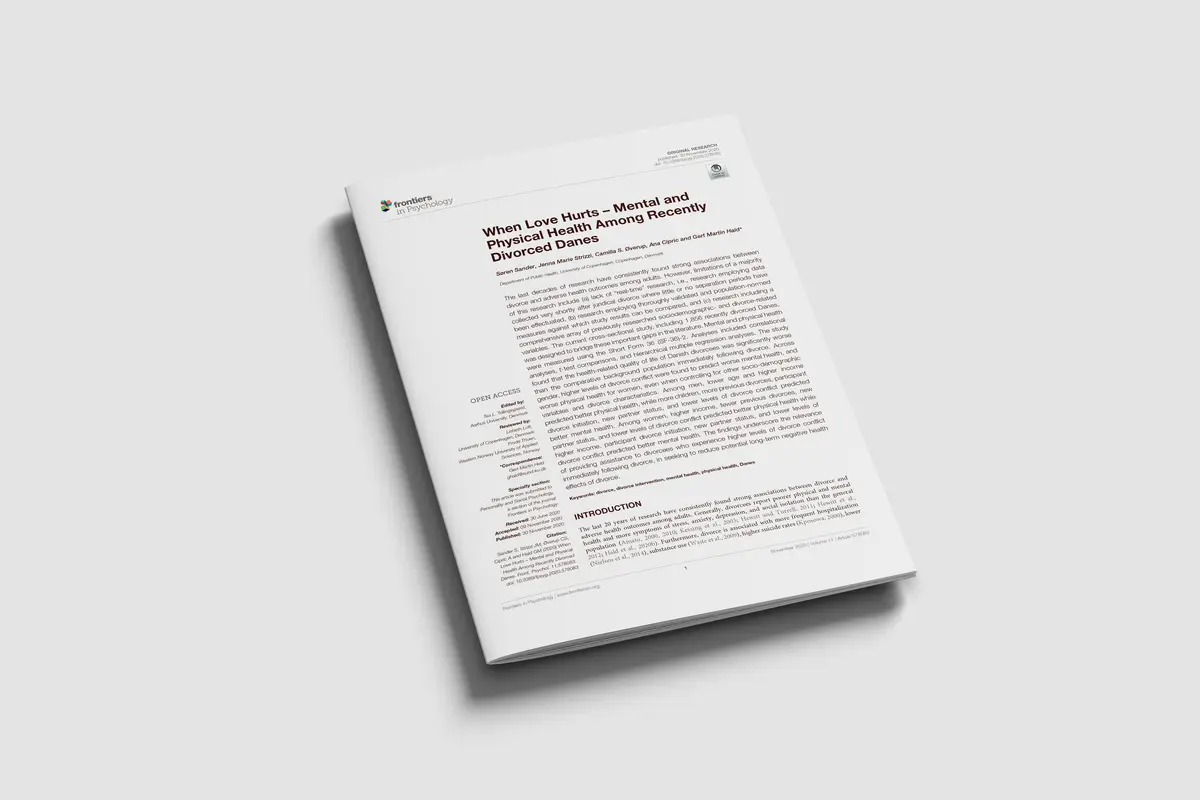
This study uses the comprehensive, validated SF-36 (eight health domains) to build a full mental and physical health profile of recently divorced Danes, collected on average just 4.74 days after legal divorce. It is among the first to combine this breadth with population-norm comparisons and a rich set of predictors — testing which sociodemographic factors (age, income, education, number of children) and divorce-related factors (marriage duration, previous divorces, who initiated, new-partner status, divorce conflict) predict health, and so who may need support most urgently.
What is SES ONE (CAD)?
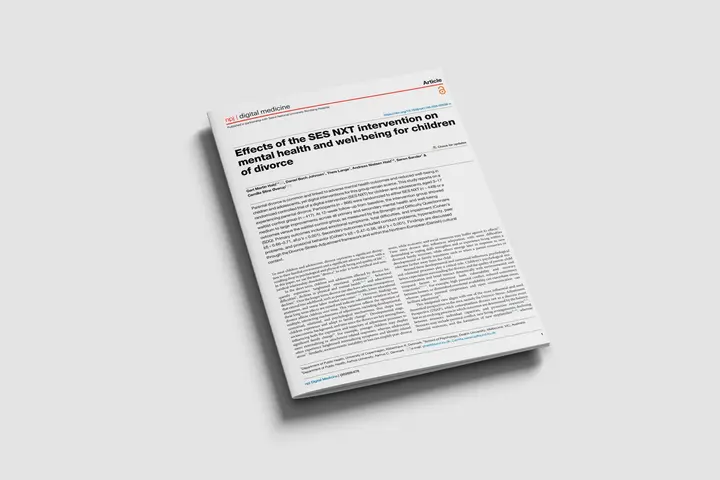
This paper reports baseline data from the CAD randomized controlled trial, before participants were randomised — describing the health status of recently divorced people at the point of entering the study, prior to any intervention. SES ONE (Cooperation after Divorce) is a free, self-paced online programme with 17 modules covering yourself, your children and co-parenting. Collecting data within days of legal divorce — before a “time heals” effect — means these results likely capture the acute health impact of divorce more accurately than any previous large-scale study.
Key findings
- Mental health was substantially worse than the background population across all four mental-health domains (large effect sizes, Cohen’s d = 0.78–1.38 for men; 0.78–1.29 for women). About 73% had below-average mental-health functioning at baseline.
- Physical health showed a more nuanced pattern. Both sexes reported better everyday physical functioning than the background population (a relatively young sample) but worse general health — consistent with a “time hurts” effect where reduced mental health increasingly affects physical health over time.
- Divorce conflict was the most consistent predictor of poor health for both men and women, even after controlling for all other variables.
- Income and new-partner status were important protective factors. Higher income predicted better health for both sexes; a new partner predicted better mental health. Even in highly equal Denmark, income remained a significant protective factor.
- There were notable sex differences in predictors — e.g. for men, initiating the divorce and having a new partner predicted better mental health; for women, income, fewer previous divorces, a new partner and lower conflict mattered across outcomes.
What does this mean in practice?
Mental-health deterioration after divorce is neither gradual nor minor: at the moment of legal divorce, before time can heal, roughly three in four people already show below-average mental-health functioning — with direct implications for healthcare services and public policy.
Divorce conflict is the most modifiable risk factor identified: unlike age or income, conflict can be reduced with the right support. This makes a strong case for offering structured support as early as possible after divorce, with conflict reduction as a primary focus — precisely the moment at which the CAD programme is made available.
Study notes
- Representativeness: Representative in age, income and marriage duration, but more women and more highly educated participants; a rake weight adjusted for this.
- Design: Cross-sectional, so causal conclusions cannot be drawn — it identifies factors associated with health at the point of divorce, not changes over time (addressed by the longitudinal RCT component).
Sander, Strizzi, Øverup, Cipric & Hald (2020). Frontiers in Psychology, 11, 578083. DOI: 10.3389/fpsyg.2020.578083 · Open access (CC BY) · Funded by the Carlsberg Foundation Distinguished Associate Professor Fellowship (CF16-0094).