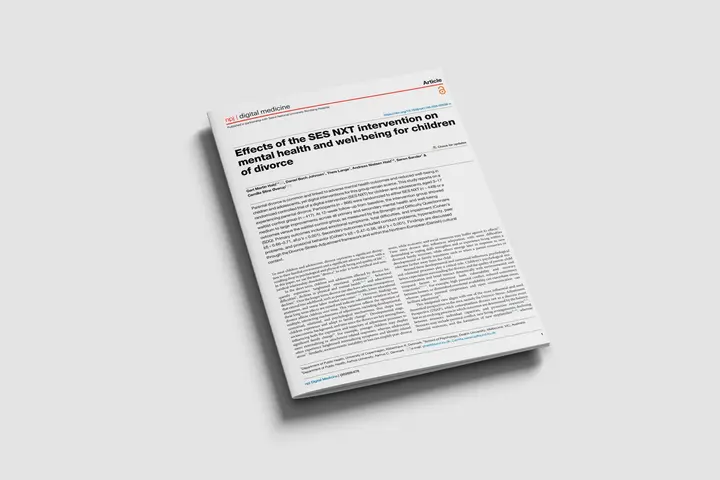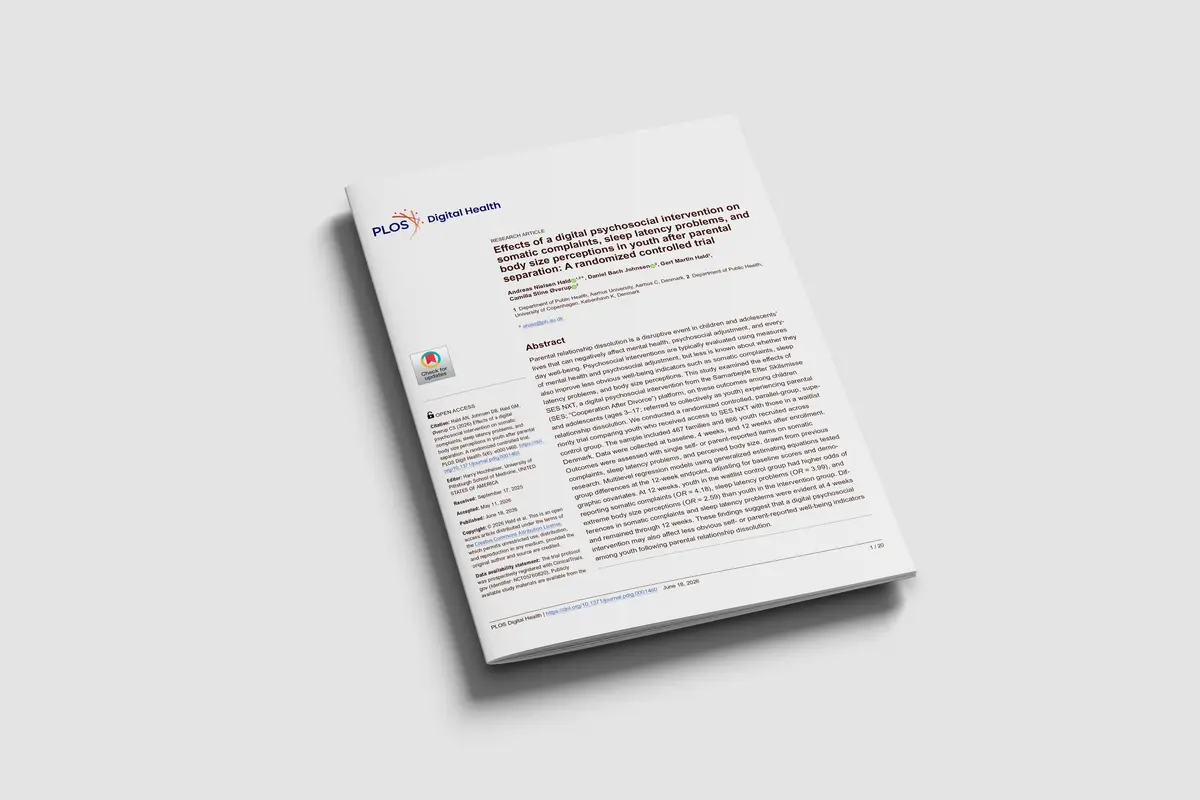
Another SES NXT article has been published — this time in PLOS Digital Health, a highly respected international journal in the field of digital health.
The study shows that SES NXT improves not only children’s mental well-being, but also the more physical, everyday indicators of distress after divorce: fewer somatic complaints, fewer sleep-latency problems, and fewer extreme body-size perceptions.
What the study found
A randomized controlled trial with 467 families and 866 youth (ages 3–17) across Denmark, with data collected at baseline, 4 weeks and 12 weeks. At 12 weeks, youth in the waitlist control group had higher odds than the intervention group of reporting:
- somatic complaints (OR = 4.18)
- sleep-latency problems (OR = 3.99)
- extreme body-size perceptions (OR = 2.59)
Differences in somatic complaints and sleep-latency problems were already evident at 4 weeks and remained through 12 weeks.
Across all three outcomes the pattern is clear: children and youth with access to SES NXT move toward fewer complaints and more positive well-being over the 12-week period — another important contribution to the evidence that SES NXT makes a real difference for children and youth after divorce.