At a glance
- d = 0.71peak effect size — youth-reported conflict reduction
- Bothchildren AND parents reported significantly less conflict
- 12 weeksto achieve medium-to-large conflict reductions
Study at a glance
- Study type: Randomized Controlled Trial (RCT)
- Country: Denmark
- Youth participants: 294 youths (ages 11–17)
- Parent participants: 467 family units
- Primary outcome: Perceived postdivorce conflict (Divorce Conflict Scale)
- Follow-up points: Baseline (T1), 4 weeks (T2), 12 weeks (T3)
What was this study about?
Parental conflict after divorce is one of the most harmful experiences for children. Most approaches to reducing it work directly with the adults — with mixed results.
This study asked a genuinely novel question rooted in family-systems theory: can a programme designed for children change how much conflict the whole family experiences? When a child gains new skills and agency, does that ripple through the family system and change interactions between the parents too?
Key findings
- At 12 weeks, youth in SES NXT reported significantly less perceived parental conflict than waitlist controls, with medium-to-large effect sizes (Cohen’s d = 0.67–0.76, unadjusted).
- Parents in SES NXT also reported significantly less postdivorce conflict (Cohen’s d = 0.62–0.81, unadjusted).
- Results held for both youth-reported and parent-reported conflict — suggesting real changes in family dynamics, not just a shift in perception on one side.
- No significant differences emerged between the different age versions of the programme.
- The “igniter” effect: the programme sparks dialogue, reflection and behaviour change that unfold long after the screen session ends — bringing quiet thoughts into the open and creating conversations families did not know they needed.
What does this mean in the real world?
When children learn to express their needs, set boundaries and communicate constructively with both parents, this appears to change the tone of interactions across the whole family — including between the parents themselves.
This opens a new and important route to reducing post-divorce conflict: rather than solely trying to change two adults who may be in an adversarial relationship, supporting the child can create change that flows upwards through the family system. It begins on the screen, but creates real impact when it moves into the family’s patterns, conversations and everyday actions.
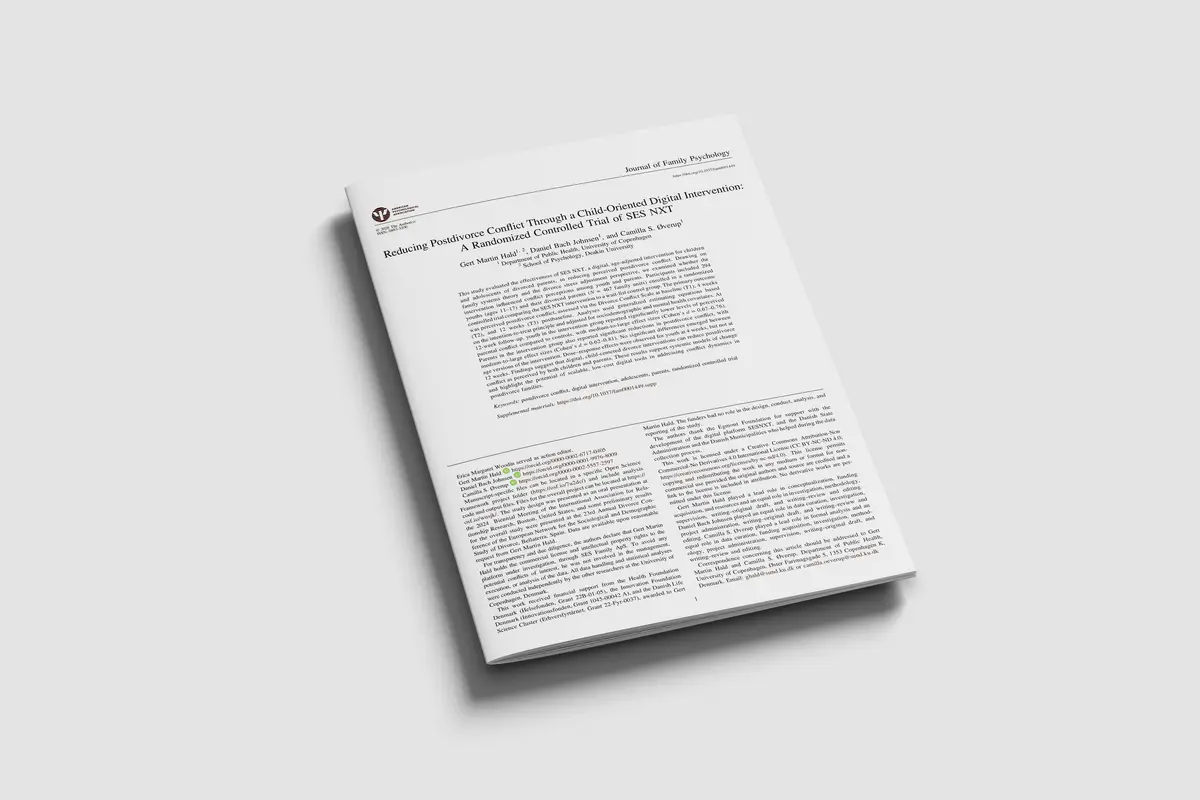
Hald, Johnsen & Øverup (2026). Journal of Family Psychology (Online First, 9 March 2026). DOI: 10.1037/fam0001449.