I korthet
- 866children aged 3–17 — one of the largest RCTs in this field
- 81%reduction in daily-life impact (vs 16% in the control group)
- ~60 mintotal engagement time to achieve these results
Study at a glance
- Study type: Randomized Controlled Trial (RCT)
- Country: Denmark — all five regions
- Participants: 866 children and adolescents (ages 3–17)
- Intervention group: n = 449
- Waitlist control: n = 417
- Follow-up points: Baseline (T1), 4 weeks (T2), 12 weeks (T3)
What was this study about?
Children whose parents divorce are at significantly higher risk of emotional problems, behavioural difficulties, lower self-esteem and academic struggles — both immediately and years later. Yet digital programmes designed specifically to help them have been almost entirely absent from the research literature.
SES NXT fills that gap. It is an age-adapted online programme for children aged 3–17, with tailored modules for four age groups (3–5, 6–8, 9–12, 13–17). Content helps children understand the divorce is not their fault, name and express their feelings, set personal boundaries and manage difficult situations, with peer-modelled videos showing other children in similar situations. Parents receive guidance on how to support their child through the programme.
Key findings
- One of the largest RCTs ever conducted in this field — 866 participants across all five Danish regions, among the most statistically robust studies of any psychosocial intervention for children of divorce to date.
- Large improvements across all seven outcome measures (Cohen’s d = .47–.71 at 12 weeks; all p’s < .001), substantially outperforming the few existing digital programmes.
- The impact scale — how much children’s difficulties disrupted daily life at home, school and with peers — fell 81% from baseline in the SES NXT group vs only 16% in controls, moving into the clinically normal range by 12 weeks while control scores stayed elevated.
- Emotional symptoms fell 53% (vs 13% in controls); peer-relationship problems fell 40% while the control group slightly worsened (+3%) — showing these problems do not resolve naturally without support.
- Prosocial behaviour rose 20% in the SES NXT group while declining slightly in controls.
- The programme worked equally across all four age groups, from 3- to 17-year-olds. About 80% of children engaged; ~72% accessed their first module the same day as or the day after baseline. A clear dose-response effect: more modules completed meant greater improvement.
What does this mean in the real world?
These substantial results were achieved with approximately 60 minutes of total engagement (4–5 modules on average), delivered entirely without therapist contact. The impact-to-time ratio is remarkable for any psychosocial intervention.
SES NXT is now one of the first programmes in the world with rigorous trial evidence that it works — from toddlers through teenagers. For parents going through a divorce, it offers something concrete and accessible: a way to actively support their child’s mental health through a difficult transition, rather than hoping time alone will heal things.
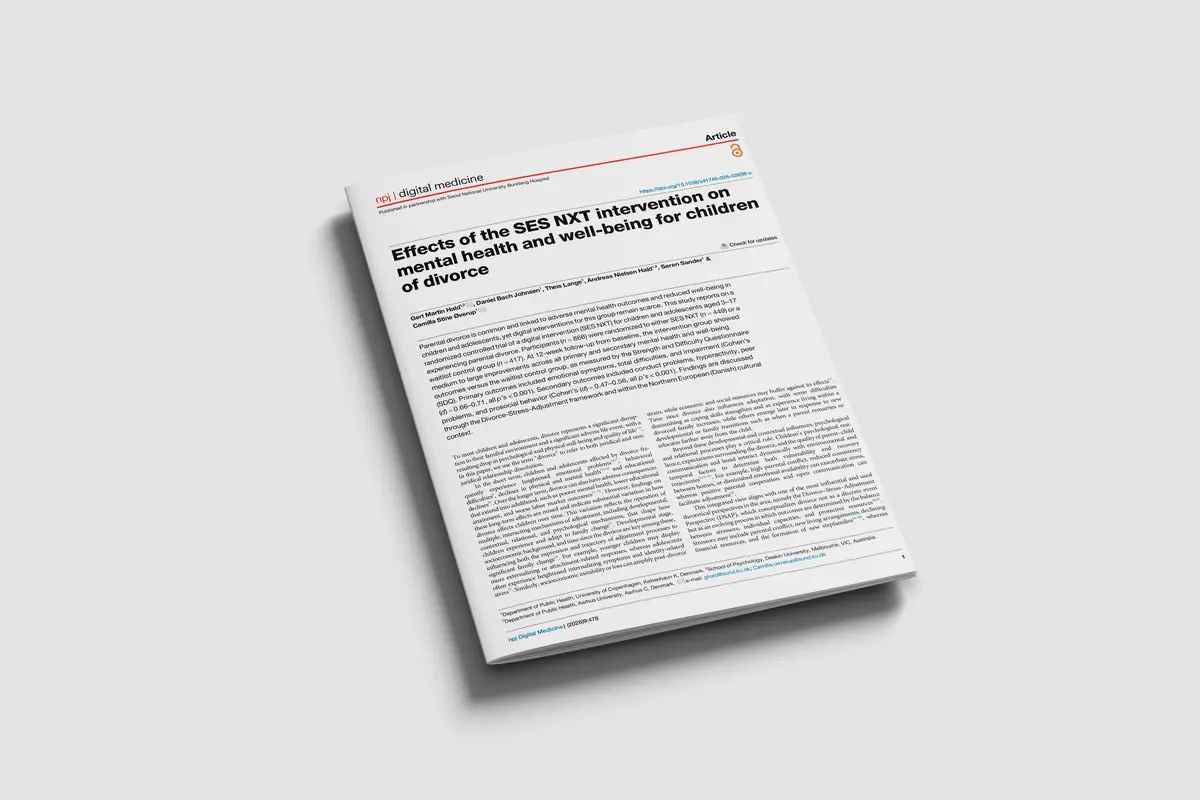
Hald, Johnsen, Lange, A.N. Hald, Sander & Øverup (2026). npj Digital Medicine. DOI: 10.1038/s41746-026-02638-x · Funded by Health Foundation Denmark (Helsefonden), Innovation Foundation Denmark, and the Danish Life Science Cluster.