At a glance
- ~32%of divorcees at the clinical anxiety threshold vs 7% in the general population
- 43–49%at the clinical depression threshold vs ~10% in the general population
- d = 0.72–1.36effect size of the difference from the general population
Study at a glance
- Study type: Cross-sectional baseline survey
- Country & period: Denmark, 2016–2018
- Time since divorce: ~5 days on average
- Total sample: n = 1,856
- Women: 66.8% (n = 1,239)
- Men: 33.2% (n = 617)
What does this study examine?
Depression and anxiety are among the most common mental-health consequences of divorce. Prior research established that divorcees have higher rates than the general population, but most studies used different measurement tools, making direct comparison difficult.
Using baseline data from the CAD randomised controlled trial, this study measured anxiety and depression in 1,856 Danes who had just received their legal divorce decree (most within five days), compared directly against Danish population norms with the same validated tool (the SCL-90-R). The central question: how elevated are anxiety and depression immediately after divorce — at a clinically meaningful level — and which factors predict who is most affected?
Key findings
- Anxiety and depression after divorce are at clinical scale, not just slightly elevated. Around 32% of both men and women scored at or above the clinical anxiety threshold (vs 7% of the general population); for depression, 43% of women and 49% of men scored above the cut-off (vs ~10%). Differences were large (Cohen’s d = 0.72–1.36).
- Conflict with the former spouse was the strongest predictor of higher depression and anxiety for both sexes, across all models — underlining how central the quality of the post-divorce relationship is to each person’s own wellbeing.
- Who initiated the divorce matters. People whose former partner initiated the divorce reported significantly higher depression and anxiety, likely reflecting a reduced sense of control.
- Not having a new partner was associated with higher depression, particularly for women — a new partner may buffer some of the emotional loss (though initiators were also more likely to have a new relationship).
- Income and education predicted mental health, especially for women. For women, lower income and education predicted both anxiety and depression; for men, education was the only socioeconomic variable that independently predicted both — suggesting relational and emotional aspects weigh more heavily for men.
What does this mean in practice?
At the point of legal divorce, roughly one in three people is experiencing clinically significant anxiety and close to half clinically significant depression. These are genuine clinical presentations that should not be left to resolve without support — a strong case for treating divorce as a public-health event, not merely an administrative or legal one.
Several at-risk groups are knowable at the point of divorce and would benefit from proactive early support: people in high-conflict divorces, those who did not initiate the divorce, women without a new partner, and those with fewer financial resources. Reducing conflict — through mediation, co-parenting support, communication tools or digital programmes like SES ONE — is likely the single most impactful lever for improving mental-health outcomes at scale.
Study notes
- Cross-sectional design: Data from a single time point, so causal relationships cannot be established; longitudinal CAD waves address some of this.
- Sample characteristics: Representative in age, income and marriage duration, but with more women and more highly educated participants; those with higher distress may be somewhat over-represented, though results align with other research.
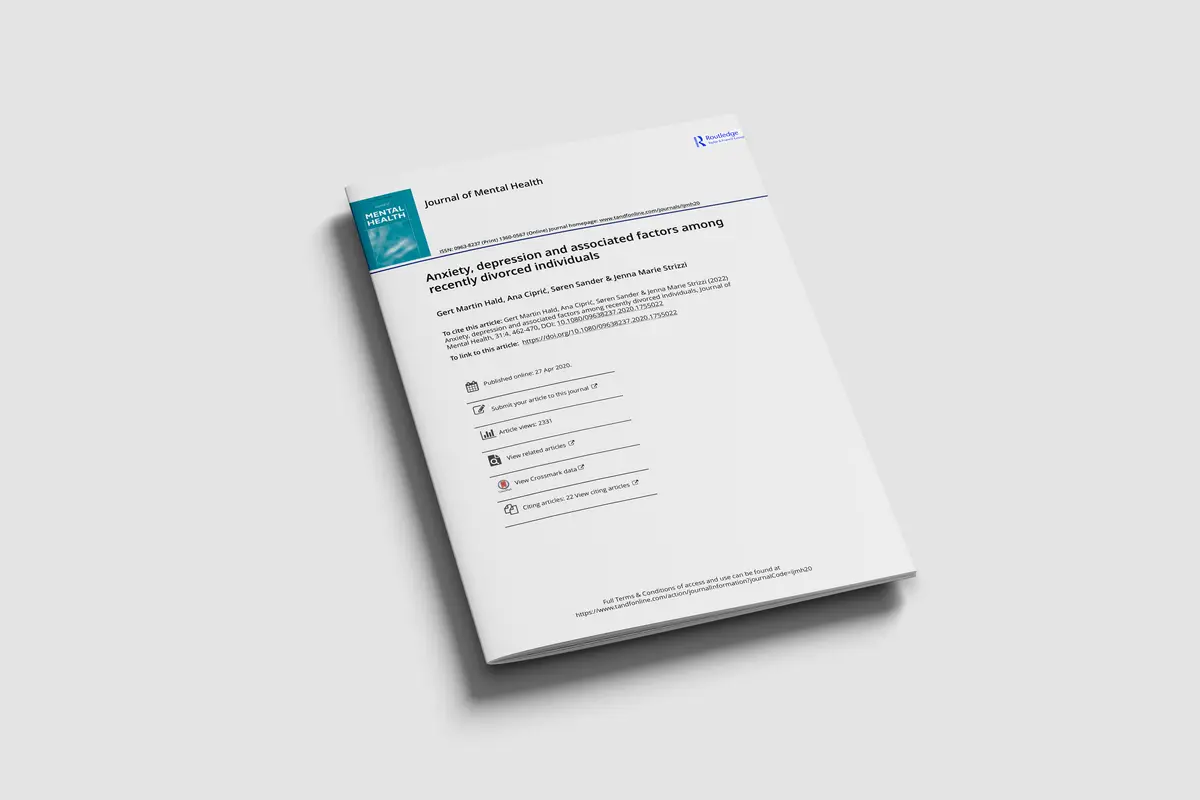
Hald, Ciprić, Sander & Strizzi (2022). Journal of Mental Health, 31(4), 462–470. DOI: 10.1080/09638237.2020.1755022 · Funded by the Carlsberg Foundation Distinguished Associate Professor Fellowship (CF16-0094).