At a glance
- 1,856recently divorced participants
- d = 1.05–1.19effect size vs general-population norms (large)
- ~5 daysaverage time from legal divorce to survey completion
Study at a glance
- Study type: Cross-sectional study (baseline data from RCT)
- Country & period: Denmark, 2016–2018
- Time since divorce: ~5 days on average
- Sample: n = 1,856 (67% women)
- Stress measure: Perceived Stress Scale (PSS)
- Comparison norms: Danish general & divorced/separated populations
What does this study examine?
Divorce is consistently ranked among the most stressful life events. Yet most studies collect data months or years afterward, by which time a natural “time heals” effect has already reduced stress — leaving the true acuity of stress at the moment of divorce largely unmeasured.
Thanks to a unique arrangement with the Danish State Administration, participants completed this survey on average just five days after their legal divorce decree, providing real-time data on stress at the point of divorce with a validated, population-normed measure. The central question: how stressed are people right at the moment of divorce, and what makes that stress worse?
What is SES ONE (CAD)?
This paper reports baseline data from the CAD randomized controlled trial, before randomisation — the stress profile of recently divorced people prior to any intervention. SES ONE (Cooperation after Divorce) is a free, self-paced online programme with 17 modules covering yourself, your children and co-parenting. Collecting data within days of legal divorce establishes a baseline against which intervention effects can be meaningfully judged.
Key findings
- Recently divorced Danes were far more stressed than both comparison groups — higher than the general population (d = 1.19 men, 1.17 women) and the divorced/separated norm (d = 1.05 men, 0.96 women). Stress at the moment of legal divorce is even higher than previously estimated, because past data were usually collected after a separation period had begun the healing process.
- Women reported higher stress than men, but the same factors predicted stress in both — lower age, lower income, lower education, infidelity as a motive, no new partner, the ex initiating the divorce, and higher conflict.
- Divorce conflict and not having a new partner were among the strongest predictors — directly relevant to what SES ONE targets (conflict reduction, communication, co-parenting and emotional processing).
- Income and education also independently predicted stress, consistent with Divorce-Stress-Readjustment theory and confirming that socioeconomically disadvantaged divorcees face a compounded stress burden.
- Gender and number of children did not predict stress even though women reported higher levels — women simply had more of the factors that do predict stress (e.g. lower income).
What does this mean in practice?
This is the most accurate estimate yet of how stressful divorce is at the moment it happens, and the effect sizes are large. This is the context in which SES ONE is offered — at a point of acute, substantial stress when the need for support is greatest.
The findings identify a clear high-risk profile (younger people, lower income/education, non-initiators, those without a new partner, those in high conflict). The strong conflict–stress association is especially actionable: conflict is not fixed, and SES ONE directly addresses conflict management and communication, suggesting its stress-reducing effects work substantially through these pathways.
Study notes
- Representativeness: Representative in age, income and marriage duration, but more women and more highly educated participants.
- Design: Cross-sectional (no causal conclusions), with a likely self-selection effect; stress trajectories are reported separately in the RCT studies.
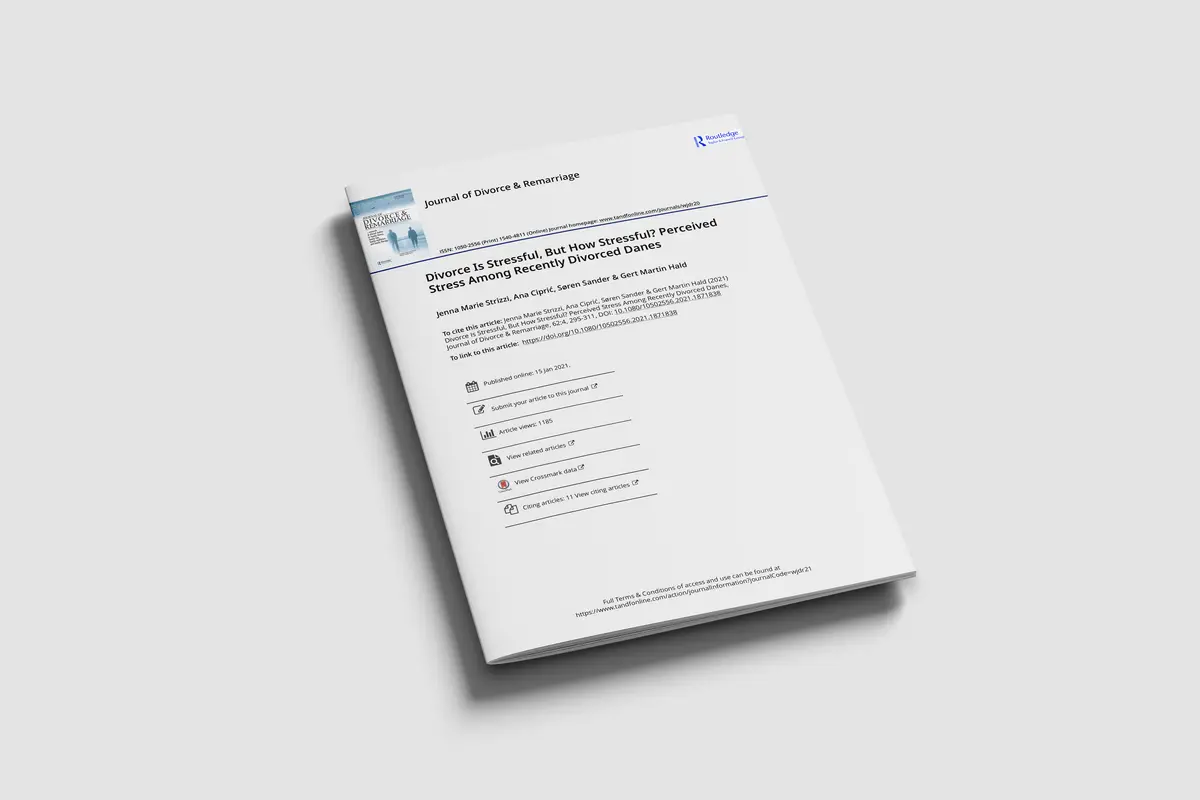
Strizzi, Cipric, Sander & Hald (2021). Journal of Divorce & Remarriage, 62(4), 295–311. DOI: 10.1080/10502556.2021.1871838 · Funded by the Carlsberg Foundation Distinguished Associate Professor Fellowship (CF16-0094).