At a glance
- 778recently divorced participants in the sick-days analysis
- 5.82 fewersick days in year one for programme users vs no support
- 9.57 vs 15.39average sick days: programme group vs control group
Study at a glance
- Study type: Randomized Controlled Trial (RCT)
- Country & period: Denmark, 2016–2018
- Time since divorce: ~5 days on average
- Programme group: n = 420
- No-support control: n = 358
- Follow-up points: Baseline, 3, 6 & 12 months
What does this study examine?
Divorce is one of the most stressful life events a person can experience, and its health consequences extend beyond emotional distress: high, prolonged stress is linked to physical illness, depression, anxiety and reduced ability to function at work and at home.
This study asked a direct, real-world question: does access to a digital support programme reduce the number of sick days taken by recently divorced adults? Sick days capture both physical illness and the emotional exhaustion that makes work impossible, making them a practical, easily understood measure of overall health and quality of life. The paper also provides the most detailed published description of the SES ONE programme — its theoretical foundations, module content, design philosophy and engagement strategies.
What is SES ONE (CAD)?
SES ONE (Cooperation after Divorce, or CAD) is a free, self-paced online programme with 17 learning modules of 15–50 minutes each, accessible from any device. It covers yourself, your children and co-parenting.
Crucially, CAD was designed from the ground up for digital delivery — not adapted from a face-to-face course. On average, users are prompted with a question, choice or interactive exercise every three minutes, and the programme integrates Cognitive Behavioural Therapy (CBT), Narrative Therapy and Acceptance and Commitment Therapy (ACT). It was built as a native digital intervention combining national scalability with genuine behaviour change — not just information delivery.
Key findings
- The programme significantly reduced sick days. Over the first 12 months, SES ONE users reported an average of 9.57 sick days vs 15.39 for the no-support group — a difference of 5.82 days (p < .001, Cohen’s d = 0.26).
- The benefit held for both men and women. Women: 12.06 vs 17.05 days (d = 0.20). Men: 5.21 vs 11.22 days (d = 0.43). Women reported more sick days overall (likely related to a greater share of childcare), but both groups benefited meaningfully.
- The scale of the effect in context. The Danish national average at the time was ~8.5 sick days per person per year. Control participants reported nearly double that; programme participants were close to the national average — suggesting divorce carries a substantial hidden health and productivity cost that a digital programme can meaningfully reduce.
What does this mean in practice?
Nearly six fewer sick days per person per year is not a marginal effect. Multiplied across the hundreds of thousands of people who divorce each year, the savings in lost productivity, healthcare costs and human suffering become substantial.
By addressing stress, depression, anxiety and somatization — all elevated after divorce — the programme likely improves overall health and reduces time off for mental-health reasons, while better co-parenting and conflict management reduce the exhaustion of ongoing conflict. There are downstream effects for children too: healthier parents are better able to parent, and fewer parental sick days mean more stable home environments.
Study notes
- Representativeness: More female, more highly educated and slightly higher income than the average Danish divorcee — may generalise somewhat less well to less-educated or lower-income groups.
- Sick-days measure: Self-reported, not exact work-absence records, but self-reported sick days are validated in Danish research as a reliable indicator of overall health-related quality of life.
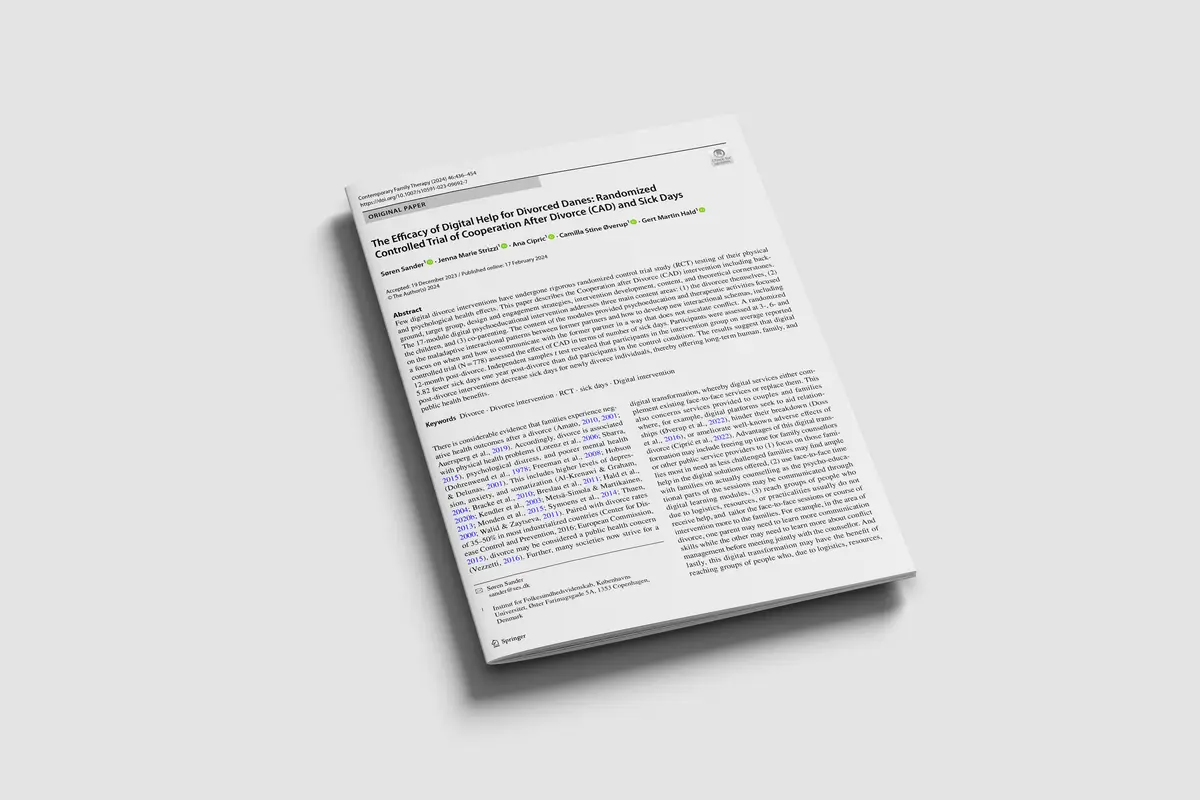
Sander, Strizzi, Cipric, Øverup & Hald (2024). Contemporary Family Therapy, 46, 436–454. DOI: 10.1007/s10591-023-09692-7 · Open access (CC BY) · Funded by the Egmont Foundation and the Carlsberg Foundation Distinguished Associate Professor Fellowship (CF16-0094).