At a glance
- 1,856recently divorced participants
- 5 of 7outcomes showed no gender difference in recovery trajectories
- 4time points tracked over 12 months
Study at a glance
- Study type: Secondary RCT analysis
- Country & period: Denmark, 2016–2018
- Time since divorce: ~5 days on average
- Women: n = 1,239
- Men: n = 617
- Follow-up points: Baseline, 3, 6 & 12 months
What does this study examine?
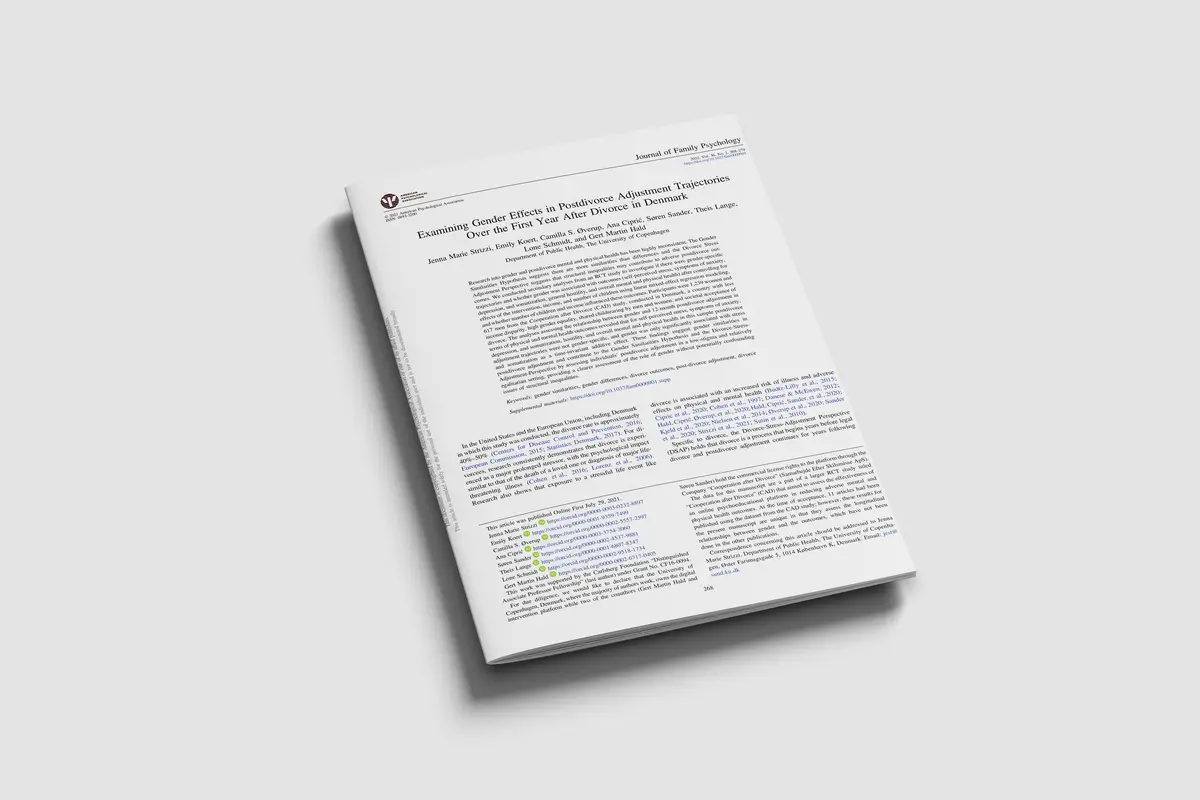
For decades, research on whether men and women experience divorce differently has produced conflicting results. A key problem: most research is conducted where men and women face very different financial and caregiving circumstances after divorce — so an apparent gender difference may actually be an income difference, or a difference in who carries the childcare burden.
The central question: do men and women follow different trajectories of mental and physical health recovery over the first year — and does gender affect the rate of recovery, or only the starting level of distress? Crucially, the study was conducted in Denmark — default 50/50 custody, shared parental leave, high gender equality and low income inequality — allowing a cleaner test with fewer confounding structural factors.
What is SES ONE (CAD)?
Seven outcomes were tracked: stress, anxiety, depression, somatization, general hostility, overall mental health and overall physical health. Rather than simply testing whether men and women score differently, the study compared three nested models (gender-specific trajectories; a stable gender difference in starting levels; no gender effect), all controlling for intervention group, number of children and income — isolating the specific contribution of gender.
Key findings
- Men and women adjusted in largely the same way. For five of seven outcomes (anxiety, depression, hostility, overall mental and physical health), there were no gender-specific trajectories and no meaningful stable difference after controlling for income and number of children.
- Women started with modestly higher stress and somatization, but the rate of improvement was identical — the gap neither widened nor narrowed, and was smaller than the normative gender gap in the general population (so not divorce-specific).
- Income explained more than gender. Removing income and number of children made apparent gender differences emerge; controlling for them made most disappear. Lower income consistently predicted worse outcomes for both sexes — much of what looks like a gender effect is, in large part, an income effect.
- Having more children was associated with better physical health for both sexes — possibly because active parenting keeps people physically engaged.
What does this mean in practice?
The findings challenge a common assumption: that men and women need fundamentally different support after divorce. Where structural inequalities are low, they recover in broadly similar ways and at similar rates — so a well-designed programme like SES ONE need not be tailored by gender to be effective for both.
Financial pressure emerges as a more important intervention target than gender-specific emotional differences. Services that help people navigate the economic consequences of divorce — a reduced income, housing costs, financial agreements — may do as much for wellbeing as emotional support alone. Gender differences seen in other countries may reflect structural inequality rather than fundamental psychological differences, and should diminish as gender equality increases.
Study notes
- Representativeness: Representative in age, income and marriage duration, but more women and more highly educated participants; may generalise less well to populations with greater structural inequality.
- Custody and context: Default 50/50 custody during the study period means most parents shared childrearing — compare cautiously with countries where custody is more asymmetric.
Strizzi, Koert, Øverup, Ciprić, Sander, Lange, Schmidt & Hald (2022). Journal of Family Psychology, 36(2), 268–279. DOI: 10.1037/fam0000901 · Funded by the Carlsberg Foundation Distinguished Associate Professor Fellowship (CF16-0094).