At a glance
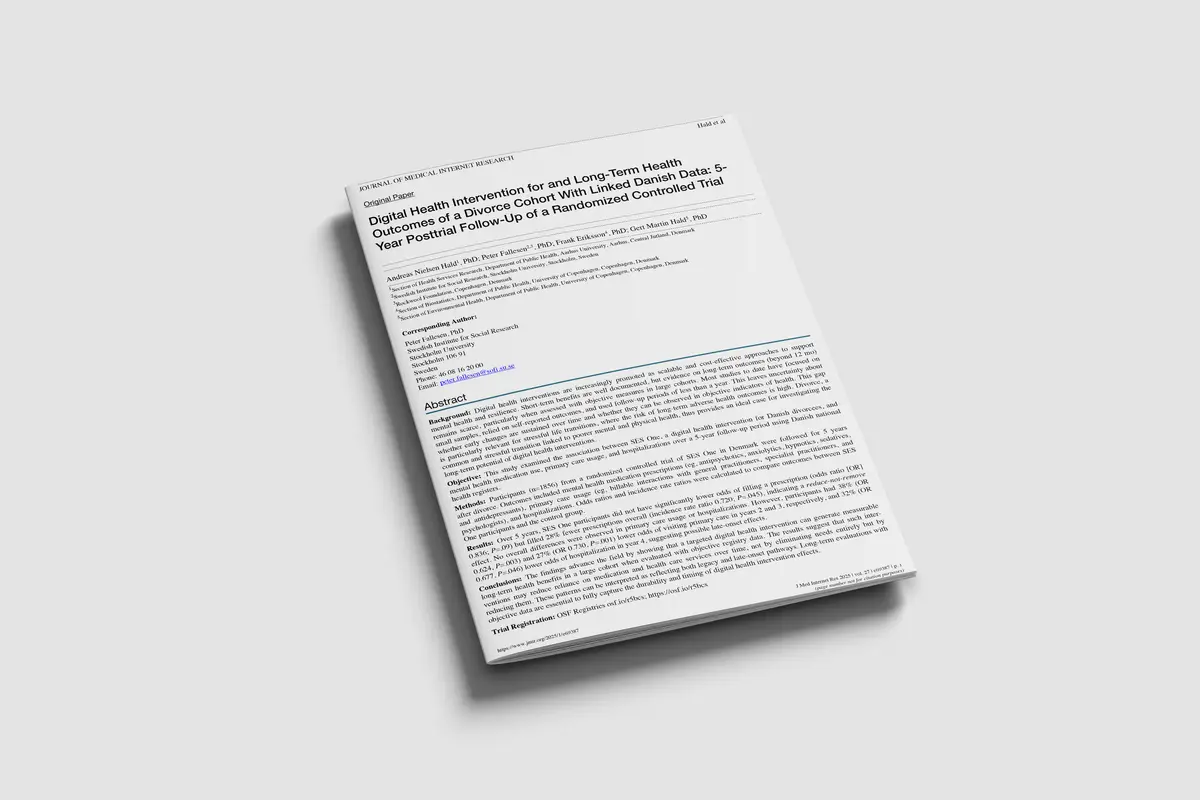
- 1,856participants followed for 5 years using objective national register data
- 28% fewermental-health prescriptions filled over 5 years vs controls
- 41% fewersedative/anti-anxiety (psycholeptic) prescriptions
Study at a glance
- Study type: 5-year post-trial observational follow-up of an RCT
- Country: Denmark
- Original RCT period: 2016–2018
- Programme group: n = 1,031
- No-support control: n = 825
- Follow-up length: 5 years post-divorce, using national health registers
What does this study examine?
Earlier studies showed SES ONE (CAD) produces strong short-term benefits — reducing stress, anxiety, depression and sick days in the first year after divorce. But a critical question remained: do those benefits last?
Using Denmark’s comprehensive national health registers, the researchers tracked the entire original RCT cohort for five full years after divorce. Instead of self-reported surveys, they used objective administrative data: actual prescriptions filled, visits billed to GPs and specialists, and hospital admissions. This is among the first studies anywhere to evaluate a digital health intervention over five or more years using objective population-level data.
What is SES ONE (CAD)?
SES ONE is a free, self-paced online programme with 17 learning modules of 30–60 minutes each, covering the divorcee themselves, the children and co-parenting. It integrates CBT, Narrative Therapy and ACT, and is “born digital” — designed for the medium, not adapted from face-to-face materials.
Because Danish register data covers everyone still in Denmark regardless of whether they responded to surveys, the study avoids the dropout bias that undermines most long-term digital-health research.
Key findings
- 28% fewer mental-health prescriptions over 5 years (3.43 vs 4.77 on average), statistically significant, with significant reductions confirmed in years 1, 4 and 5.
- 41% fewer sedative and anti-anxiety prescriptions specifically. The strongest effect was for psycholeptics — anti-anxiety medications, sedatives, hypnotics and antipsychotics — often prescribed in response to the acute distress following major life disruptions.
- Fewer GP visits in years 2–3, and fewer hospitalisations in year 4. SES ONE participants had 38% lower odds of a primary-care visit in year 2, 27% lower in year 3, and 32% lower odds of hospitalisation in year 4 — “late-onset” effects emerging gradually rather than immediately.
- A “reduce, not remove” pattern. The proportion filling any prescription was similar between groups; the difference was in how many prescriptions medication users filled — a realistic expectation for a preventive digital intervention.
What does this mean in practice?
Legacy effects: the early coping skills and psychological stabilisation gained in the first year appear to have lasting protective effects, leaving people better equipped to manage ongoing post-divorce stressors and reducing later need for medication and care.
Late-onset effects: some benefits only became visible after 2–4 years, possibly reflecting the gradual accumulation of unaddressed distress in the control group — a trajectory SES ONE may have interrupted.
Providing scalable digital support at the point of divorce is therefore not just a short-term intervention, but an investment in long-term public health, with measurable, lasting reductions in medication use and healthcare costs.
Study notes
- Attrition: Because data came from registers, nearly all participants were retained; only 3.1% exited (emigration or death), balanced across groups.
- Generalisability: Participants were more likely to be women, first-time divorcees and highly educated than average; reweighting to the full Danish divorce population kept findings largely consistent.
Hald AN, Fallesen P, Eriksson F & Hald GM (2025). Journal of Medical Internet Research, 27, e69387. DOI: 10.2196/69387 · Open access (CC BY) · Funded by the ROCKWOOL Foundation (grant 1263), the Egmont Foundation, and the Carlsberg Foundation (CF16-0094).