At a glance
- 676participants with personality data from the CAD RCT
- Neuroticismthe single strongest personality predictor of post-divorce mental health
- Equalprogramme benefit regardless of personality profile
Study at a glance
- Study type: Secondary RCT analysis
- Country & period: Denmark, 2016–2018
- Programme group: n = 377
- No-support control: n = 299
- Personality measured: ~1 month post-divorce
- Follow-up points: Baseline, 3, 6 & 12 months
What does this study examine?
People adjust to divorce in very different ways. Research has identified many external factors (income, conflict, who initiated) but much less is known about stable personality traits, which shape how people respond to stress, seek support and draw on their own resources.
This is the first study to examine all five Big Five dimensions in relation to multiple mental-health outcomes tracked at four time points after divorce. The central question: does personality shape how mental health changes over the year following divorce — and does it affect how much benefit people gain from SES ONE?
What is SES ONE (CAD)?
The Big Five traits — neuroticism (intense negative emotions, instability under stress), extraversion, openness, agreeableness and conscientiousness — were measured with the validated Danish NEO-FFI-3 (60 items) about one month after legal divorce. Four nested models were compared for each outcome: no personality effect; a main effect; a personality-by-time interaction (does personality shape the trajectory?); and a personality-by-intervention-by-time interaction (does personality moderate programme benefit?).
Key findings
- Neuroticism was the strongest predictor of mental health after divorce — higher neuroticism meant worse anxiety, depression, somatization and stress at divorce and at every follow-up across 12 months. No other trait showed this consistent pattern.
- Higher-neuroticism individuals improved more rapidly — but remained worse off throughout. Despite steeper declines, they still reported higher symptoms at 3, 6 and 12 months: the gap narrowed but did not close.
- Agreeableness was associated with faster depression recovery (specific to depression), consistent with more cooperative people drawing on social support and navigating co-parenting more effectively.
- The programme benefited people equally regardless of personality. There was no evidence SES ONE worked better or worse for any personality profile — it is effective as a universal offer.
What does this mean in practice?
Personality — specifically neuroticism — is a meaningful risk factor for poor mental health after divorce. People who experience emotions intensely and find stress hard to manage are likely to have a harder immediate aftermath and remain at higher symptom levels through the first year even as they improve. Brief personality screening at divorce could help identify those most likely to need early or intensive support.
For individuals, the message matters: a higher initial reaction does not predict a poorer eventual outcome — people who find divorce acutely distressing can and do improve substantially, and the programme works for them just as well. SES ONE does not need to be adapted by personality type; its multi-module structure offers something relevant regardless of profile, supporting use as a universal first-line resource.
Study notes
- Personality measurement timing: measured ~1 month after legal divorce (not before); personality is generally stable, but pre-divorce data were not available.
- Smaller subsample: personality data came from n = 676 of the full 1,856; drop-outs tended to have lower extraversion and higher anxiety, so generalise extraversion findings with some caution.
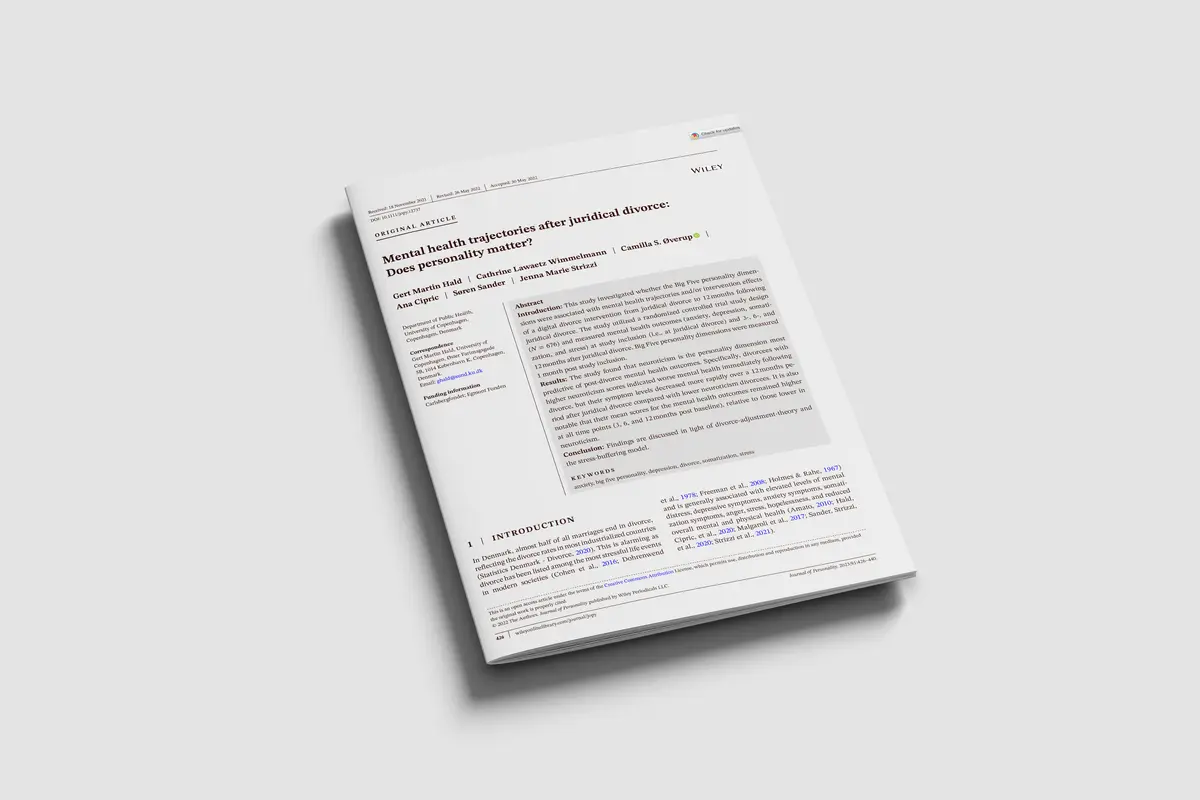
Hald, Wimmelmann, Øverup, Cipric, Sander & Strizzi (2023). Journal of Personality, 91, 426–440. DOI: 10.1111/jopy.12737 · Open access (CC BY) · Funded by the Carlsberg Foundation Distinguished Associate Professor Fellowship (CF16-0094).