I korthet
- 1,564recently divorced parents across two validation samples
- 6 itemsfinal validated scale covering key dimensions of post-divorce conflict
- α = .88excellent internal consistency across both samples
Study at a glance
- Study type: Scale development & validation
- Country & period: Denmark, 2015–2018
- Sample 1 (development): n = 1,144 parents
- Sample 2 (confirmation): n = 420 parents
- Time since divorce: ~5 days on average
- Scale format: 6 items, self-report
What does this study examine?
Conflict after divorce is one of the strongest predictors of poor outcomes for both adults and children, and high-conflict cases account for a disproportionate share of family-court resources (estimated up to 90% of court time for just 5–25% of cases).
Yet when this study was conducted there was no validated short measure of post-divorce conflict — researchers typically used single-item or unvalidated questions. The central question: how do we reliably measure conflict after divorce? This study developed and validated the Divorce Conflict Scale (DCS), a brief 6-item instrument, now used as the standard measure in all SES ONE research.
What does the DCS measure?
The six items cover communication quality, self-perceived degree of conflict, ease of talking about the children, ability to attend family events without tension, ability to handle conflicts constructively, and respect for the former spouse. Together they span three theoretical dimensions: the domain dimension (what they disagree about), the tactics dimension (how they handle disagreements) and the attitudinal dimension (hostility and disrespect).
The scale was developed with exploratory factor analysis on the first sample and confirmed with confirmatory factor analysis on the second — both supporting a single underlying dimension, with full equivalence across men and women.
Key findings
- Excellent psychometric properties: a clear single-factor structure (items explaining 63% of variance), good model fit, high internal consistency (Cronbach’s α = .88) and equivalence across men and women.
- Women reported higher average conflict scores than men (d = −0.16, small) — possibly reflecting the acute timing and the share of women who initiated.
- Violence and infidelity were strongly linked to higher conflict (violence the single strongest predictor for women).
- Mutual divorce agreement was associated with the lowest conflict — cooperative capacity before divorce translates into better communication afterwards.
- When only the former spouse has a new partner, conflict is highest (for women) — reflecting dynamics of perceived abandonment or replacement.
What does this mean in practice?
The DCS gives researchers, clinicians and policymakers a validated tool to measure conflict quickly and reliably. Its brevity (6 items, under two minutes) makes it practical for screening, court procedures and intervention studies.
From a public-health standpoint, early identification of high-conflict cases is valuable precisely because these are where intervention matters most — high-conflict divorce is harmful to adults, deeply harmful to children and resource-intensive for public services. The DCS has since been used across all SES ONE research, enabling conflict to be tracked as both an outcome and a moderator of programme effectiveness.
Study notes
- Validation gaps: test-retest reliability and external convergent/divergent validity were not assessed; cutoff thresholds for low/moderate/high conflict would add practical utility.
- Sample scope: both samples were heterosexual married parents in Denmark; extension to non-married, non-heterosexual and other cultural contexts is encouraged.
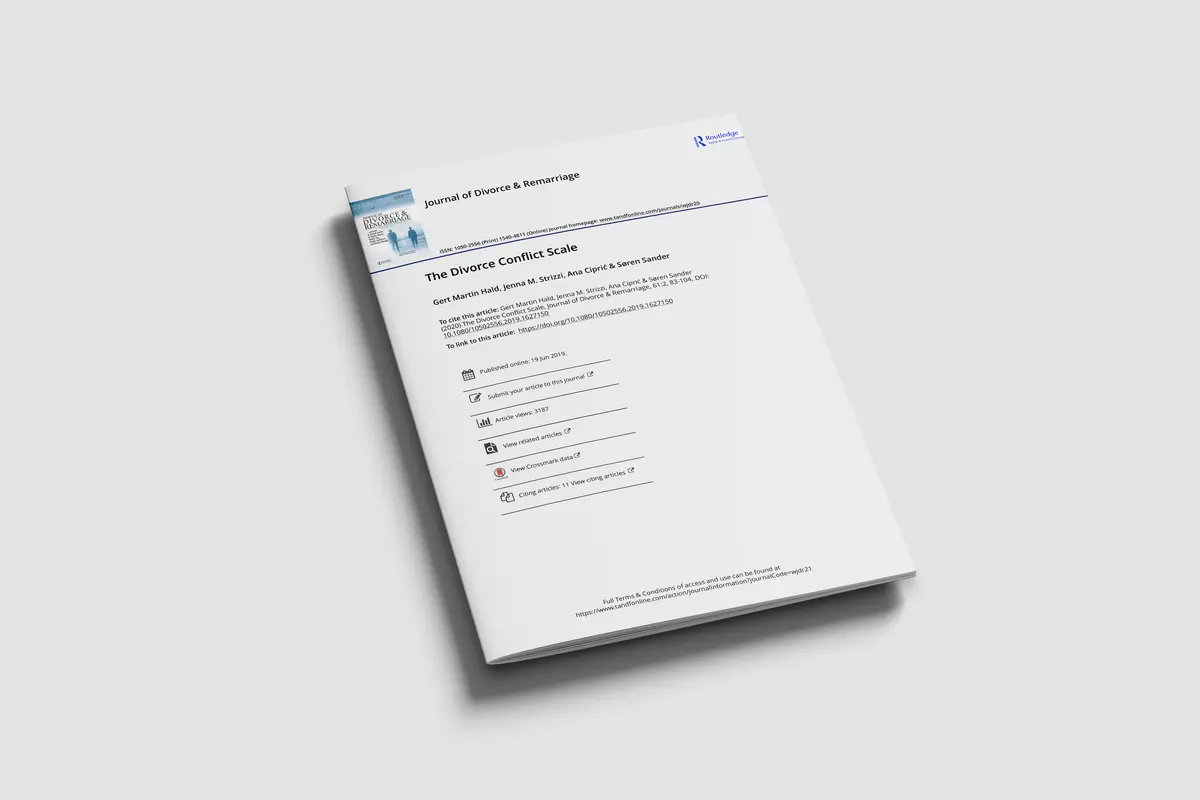
Hald, Strizzi, Ciprić & Sander (2020). Journal of Divorce & Remarriage, 61(2), 83–104. DOI: 10.1080/10502556.2019.1627150 · Funded by the Carlsberg Foundation (CF16-0094).