I korthet
- 2,371recently divorced participants
- 47%cited lack of love/intimacy as a motive (the most common reason)
- ~5 daysaverage time from legal divorce to survey completion
Study at a glance
- Study type: Descriptive study (baseline data from RCT)
- Country & period: Denmark, 2016–2018
- Time since divorce: ~5 days on average
- Sample: n = 2,371 (66% women)
- Divorce motives assessed: 13 predetermined categories + open responses
- Average marriage length: 12.65 years
What does this study examine?
Understanding why people divorce matters for clinicians, researchers and those developing interventions. Yet previous research typically relies on retrospective data collected years after divorce, when memory may be affected by time and stress.
Thanks to a unique arrangement with the Danish State Administration, participants completed this survey within days of receiving their legal divorce decree — the first large-scale study to assess divorce motives immediately following legal divorce, substantially reducing recall bias. The central question: what motives do recently divorced Danes give for ending their marriages? It also examines whether motives cluster into categories and whether men and women differ.
What is SES ONE (CAD)?
This paper reports baseline data from the CAD randomized controlled trial, before randomisation — a picture of why people divorce in Denmark, independent of any intervention. SES ONE (Cooperation after Divorce) is a free, self-paced online programme with 17 modules covering yourself, your children and co-parenting. Collecting data within days of legal divorce minimises the recall bias that affects most previous studies.
Key findings
- Emotional and relational motives dominated, not behavioural ones. The four most cited: lack of love/intimacy (47%), communication problems (44%), lack of sympathy/respect/trust (34%) and growing apart (32%). The least cited were violence (6%), addiction (6%) and accident/illness (7%).
- Motives did not form clear, distinct clusters. A factor analysis found five broad clusters but with heavy cross-loading — individuals’ motives are heterogeneous and multifactorial.
- Men and women differed on several motives. Men were more likely to cite lack of love/intimacy and sexual problems; women were more likely to cite infidelity, addiction and violence.
- Direct relevance for therapy and intervention design. Communication problems were the second most common motive overall, and communication quality is strongly linked to relationship stability — pointing to what intervention content should address.
What does this mean in practice?
The dominance of emotional and relational motives over behavioural ones reflects a broader societal shift in what people expect from marriage: in a high-equality society like Denmark, people appear to leave primarily because of emotional disconnection, not material necessity.
For therapists and counsellors, the most common motives point to where therapeutic focus may help most — communication skills, rebuilding intimacy and connection, and rebuilding trust. For divorce support programmes, content addressing emotional processing, communication and rebuilding trust and respect is likely most relevant — themes directly reflected in SES ONE.
Study notes
- Representativeness: Representative in age, income and marriage duration, but more women and more highly educated participants; may not fully generalise to less-educated groups or other countries.
- Limitations: The study cannot identify whether behaviours such as infidelity, addiction or violence were attributable to the participant or the former spouse, nor assess dyadic patterns (former spouses were not linked in the data).
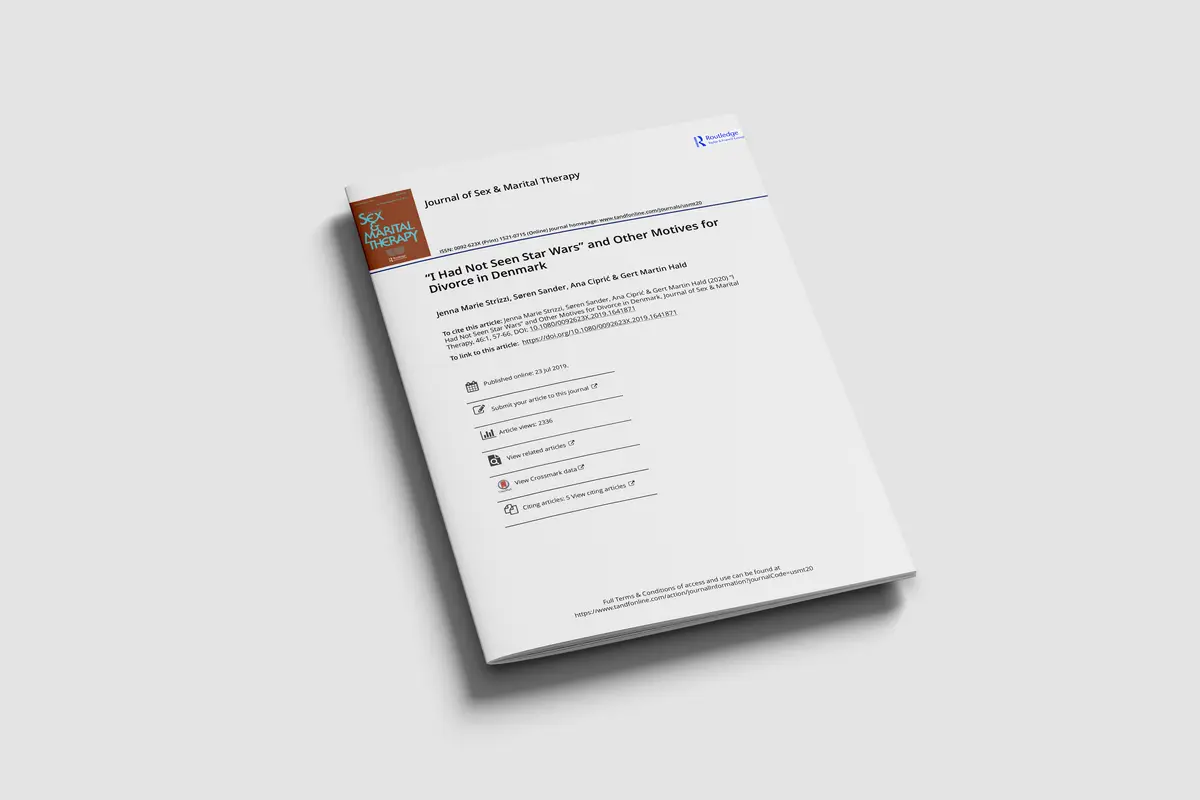
Strizzi, Sander, Cipric & Hald (2020). Journal of Sex & Marital Therapy, 46(1), 57–66. DOI: 10.1080/0092623X.2019.1641871 · Funded by the Carlsberg Foundation Distinguished Associate Professor Fellowship (CF16-0094).