I korthet
- 1,856recently divorced participants
- No moderationof intervention effect by income or education (with one exception)
- 5 outcomesexamined: stress, depression, anxiety, mental & physical health
Study at a glance
- Study type: RCT moderator analysis
- Country & period: Denmark, 2016–2018
- Time since divorce: ~5 days on average
- Programme group: n = 1,031
- No-support control: n = 825
- Follow-up points: Baseline, 3, 6 & 12 months
What does this study examine?
Previous CAD research showed SES ONE reduces stress, depression, anxiety and hostility and improves mental and physical health. But a key question remained: does the programme work equally well for everyone, regardless of socioeconomic background?
Lower income and education are consistently linked to worse health after divorce and slower recovery. If the programme is less effective for these groups, public-health strategies may need adapting; if it is equally effective, that is powerful evidence for scalability across the whole divorced population. The study investigated whether income and education (1) predict post-divorce health, (2) moderate natural change over time and (3) moderate the intervention effect, across five outcomes: stress, depression, anxiety, mental health and physical health.
What is SES ONE (CAD)?
SES ONE (Cooperation after Divorce, or CAD) is a free, self-paced online programme with 17 learning modules of 30–60 minutes each (participants averaged 4.27 modules), covering yourself, your children and co-parenting. Participants were recruited through the Danish State Administration and randomised into the programme group or a no-support control — the most rigorous way to test whether a programme actually works.
Key findings
- Lower income and lower education predicted worse health after divorce across all five outcomes — confirming that socioeconomic disadvantage compounds the health burden of divorce.
- SES ONE was equally effective across income and education levels. With one exception, neither income nor education moderated the programme’s effect on any outcome — a strong finding for scalability and population-level public-health potential.
- The one exception: lower-educated participants showed greater depression reductions from using SES ONE — consistent with the resource-substitution hypothesis, where the programme substitutes for resources (psychological literacy, formal support networks) that lower-educated people have less access to.
- Lower-educated participants also showed larger natural reductions in anxiety over time, partly reflecting a floor/ceiling effect (higher starting anxiety, more room to improve).
What does this mean in practice?
A central question for any public-health intervention is whether it works for the people who need it most — not just those with the most resources. This study provides reassuring evidence that SES ONE does: its benefits are not limited to higher-income or more-educated people.
That lower-educated participants may benefit even more on depression is especially meaningful: it suggests SES ONE may help reduce post-divorce health inequalities, not just average health, by providing structured psychoeducation and coping tools that compensate for resources higher education typically provides. These results support making SES ONE universally available as a standard part of the divorce process.
Study notes
- Representativeness: Representative in age, income and marriage duration, but with more women and more highly educated participants — though the finding for lower-educated participants is particularly encouraging.
- Attrition: High dropout (common online) with only very limited bias; all available data used.
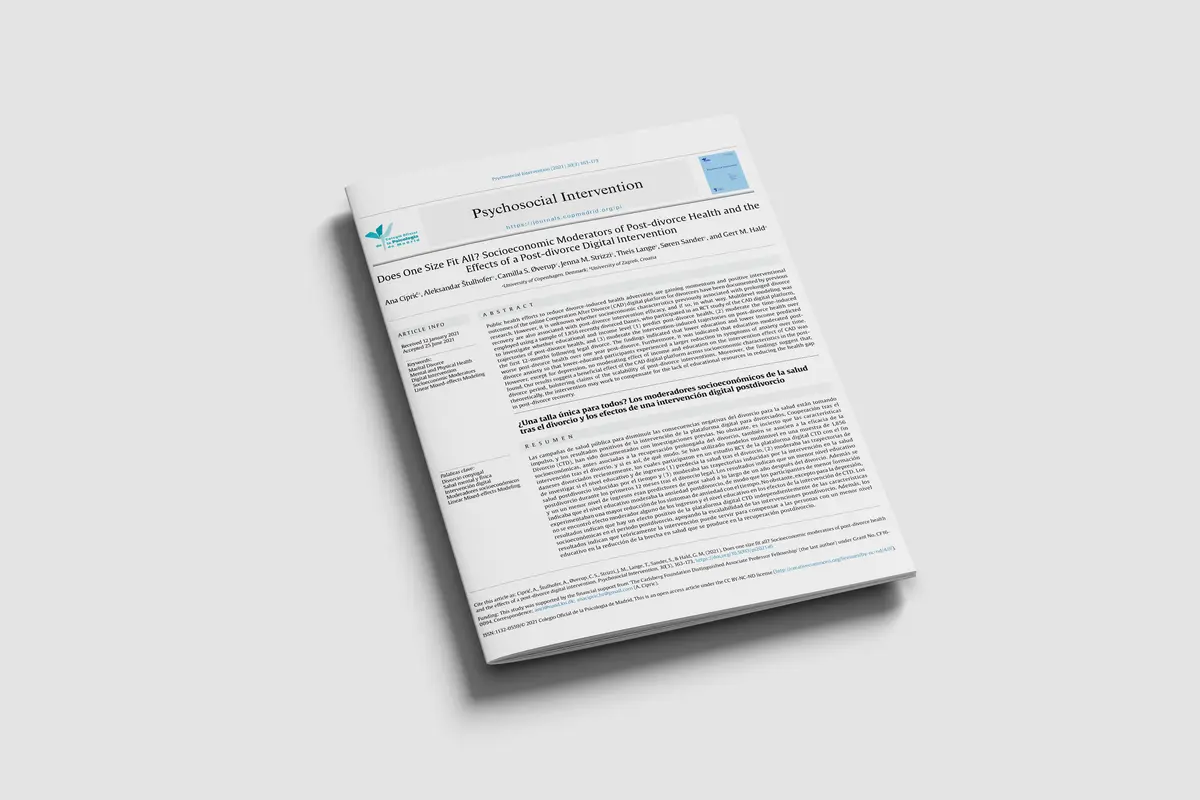
Cipric, Štulhofer, Øverup, Strizzi, Lange, Sander & Hald (2021). Psychosocial Intervention, 30(3), 163–173. DOI: 10.5093/pi2021a6 · Open access (CC BY-NC-ND) · Funded by the Carlsberg Foundation Distinguished Associate Professor Fellowship (CF16-0094).