I korthet
- 1,856recently divorced participants
- 30% vs 60%with impaired mental health at 12 months (programme vs no support)
- d = 1.52–1.86adjusted effect size for mental health improvement
Study at a glance
- Study type: Randomized Controlled Trial (RCT)
- Country & period: Denmark, 2016–2018
- Time since divorce: ~5 days on average
- Programme group: n = 1,031
- No-support control: n = 825
- Follow-up points: Baseline, 3, 6 & 12 months
What does this study examine?
Divorce is one of the most stressful life events a person can face, and its health consequences are far-reaching: recently divorced adults consistently report more depression, anxiety and stress — and poorer physical and mental health — than their married counterparts.
The central question: can a digital programme improve mental and physical health after divorce?
Participants completed their baseline survey on average just 4.74 days after their legal divorce decree, capturing health at one of the most acute moments. At that point, roughly 75% of both groups had below-average mental-health functioning. The study used the SF-36, a validated instrument measuring eight health domains, to build a comprehensive picture over a full year — among the first large-scale longitudinal RCTs to examine these outcomes among recently divorced adults.
What is SES ONE (CAD)?
SES ONE (Cooperation after Divorce, or CAD) is a free, self-paced online programme with 17 learning modules of 30–60 minutes each, accessible from any device (participants averaged 4.27 modules). It covers three core areas — yourself, your children and co-parenting. Participants were recruited through the Danish State Administration and randomised into the programme group or a no-support control. A randomized controlled trial is the most rigorous way to test whether a programme actually works, rather than simply attracting people who were already recovering.
Key findings
- SES ONE significantly improved both mental and physical health. At 3 months, the mental-health effect was large (Cohen’s d = 1.52) and the physical-health effect small but meaningful (d = 0.21); both held after controlling for dropout.
- Mental-health benefits grew and were sustained at 12 months. Below-average mental-health functioning fell from ~75% at baseline to 30% in the SES ONE group, while remaining at 60% in the no-support group.
- Physical-health benefits were evident at 6 months. The no-support group declined gradually over the year; SES ONE buffered this, with a significant difference at 6 months. At 12 months the difference stayed directionally consistent but was no longer statistically significant after adjusting for dropout.
- Improvements spanned all eight health domains — physical functioning, role limitations (physical), bodily pain, general health, vitality, social functioning, role limitations (emotional) and mental health — at every follow-up. The benefits are broad, not confined to one area.
- The benefit was equal for men and women.
What does this mean in practice?
The health consequences of divorce are not limited to how people feel in the first weeks. Without support, mental and physical health can stay significantly below average for well over a year, with real consequences for work capacity, healthcare use and quality of life.
SES ONE appears to interrupt that decline by giving people relevant, on-demand content at the moment they need it most — building coping skills, emotional regulation and practical knowledge. Making a programme like SES ONE a standard part of the divorce process could reduce the public-health burden divorce places on healthcare systems: better health-related quality of life is associated with lower hospitalisation, fewer sick days and reduced healthcare costs.
Study notes
- Representativeness: Representative of Danish divorcees in age, income and marriage duration, but with more women and more highly educated participants — may generalise somewhat less well to less-educated groups.
- Attrition: Dropout was high (common in online studies), but analyses found no meaningful bias and used all available data.
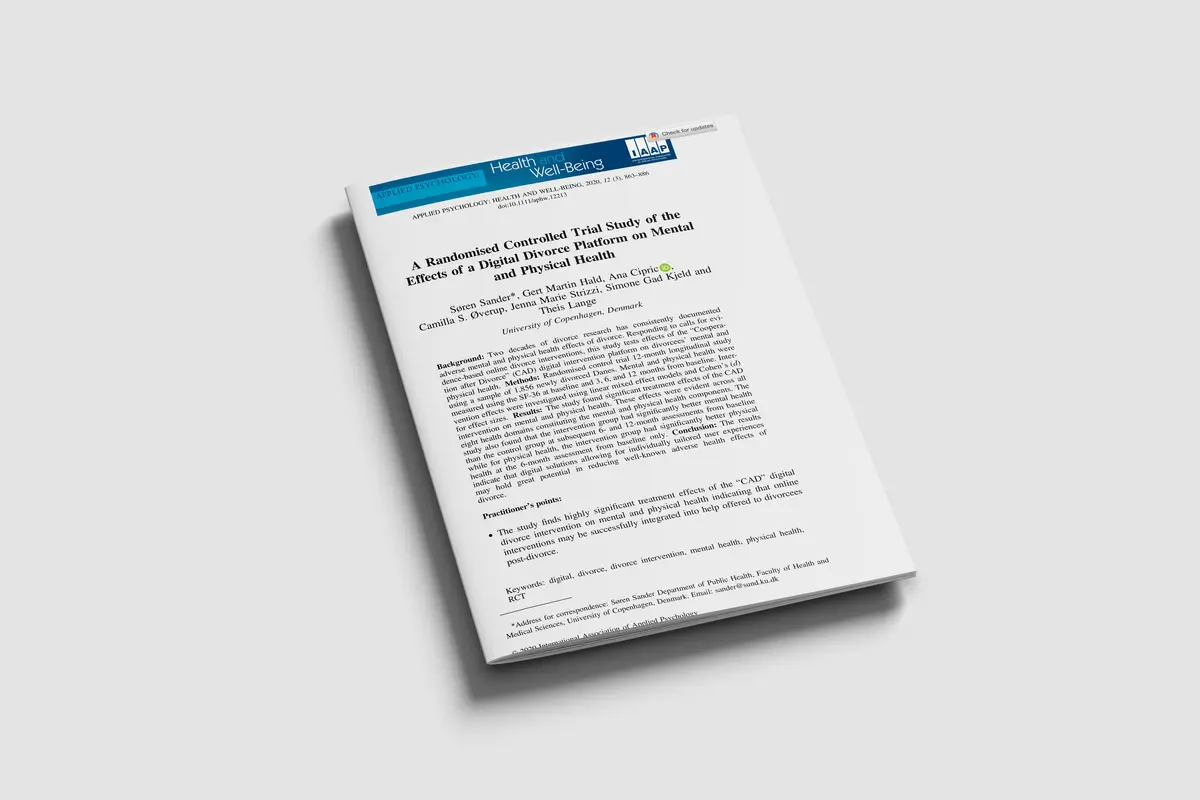
Sander, Hald, Cipric, Øverup, Strizzi, Gad Kjeld & Lange (2020). Applied Psychology: Health and Well-Being, 12(3), 863–886. DOI: 10.1111/aphw.12213 · Funded by the Carlsberg Foundation Distinguished Associate Professor Fellowship (CF16-0094).