I korthet
- ~50%of divorcees show clinical-level depression immediately after divorce
- ~20%show problematic hostility at the point of divorce
- No chaindepression and hostility improve in parallel, neither driving the other
Study at a glance
- Study type: Secondary RCT analysis
- Country & period: Denmark, 2016–2018
- Time since divorce: ~5 days on average
- Programme group: n = 1,050
- No-support control: n = 832
- Follow-up points: Baseline, 3, 6 & 12 months
What does this study examine?
Divorce interventions like SES ONE reduce both depression and hostility. Depression is one of the most common responses to divorce; hostility — persistent mistrust, cynical attitudes and irritable or angry behaviour — affects roughly one in five newly divorced people and is not limited to the former partner: it can affect children, family and colleagues, and is linked to poorer physical health including cardiovascular risk.
What had not been studied is whether the programme works by tackling these in sequence. Does reducing depression lead to less hostility, or vice versa — or do both improve independently? The answer matters for how support content is designed and sequenced.
What is SES ONE (CAD)?
Hostility was measured using the six-item SCL-90-R Hostility subscale (general hostile feelings and behaviours toward others, not just the ex-spouse). Structural equation modelling tested whether depression at one time point predicted hostility at the next, and vice versa; a gender-constrained model was compared with one allowing separate estimates for men and women.
Key findings
- The programme reduced both depression and hostility at every follow-up (3, 6 and 12 months) vs no support. The question was how.
- Depression and hostility were strongly linked at each point in time — when someone was more depressed they also tended to be more hostile, consistent with shared features like irritability and interpersonal sensitivity.
- Neither outcome reliably predicted the other over time. With one minor exception (higher baseline depression predicted slightly higher hostility at 3 months), the two changed in parallel rather than in sequence.
- The programme likely affected both outcomes through its range of content simultaneously — modules on grief, negative thoughts and anger management (depression) alongside communication, conflict reduction and co-parenting (hostility), all available from the start.
- These patterns were the same for men and women — a gender-equal model fit best.
What does this mean in practice?
Depression and hostility after divorce improve together, rather than one following from the other — so both deserve direct attention. There is no evidence for a “fix depression first and hostility will follow” approach (or the reverse). A programme covering only the emotional self-experience of divorce, without interpersonal and co-parenting content, would likely be less effective.
For practitioners, the same principle holds: treating depression alone is unlikely to resolve hostility, and vice versa — both need direct attention at the same time. SES ONE’s multi-module structure, covering personal emotional processing and interpersonal/co-parenting skills in parallel, fits this reality: engaging with both at once appears to be how recovery actually happens.
Study notes
- Post-hoc analysis: This examined a mechanism question not in the original RCT design; prospective-association findings should be read in that exploratory context.
- General vs partner-specific hostility: Hostility was measured as a general disposition toward others, not specifically toward the former partner — a separate question for future research with repeated conflict measures.
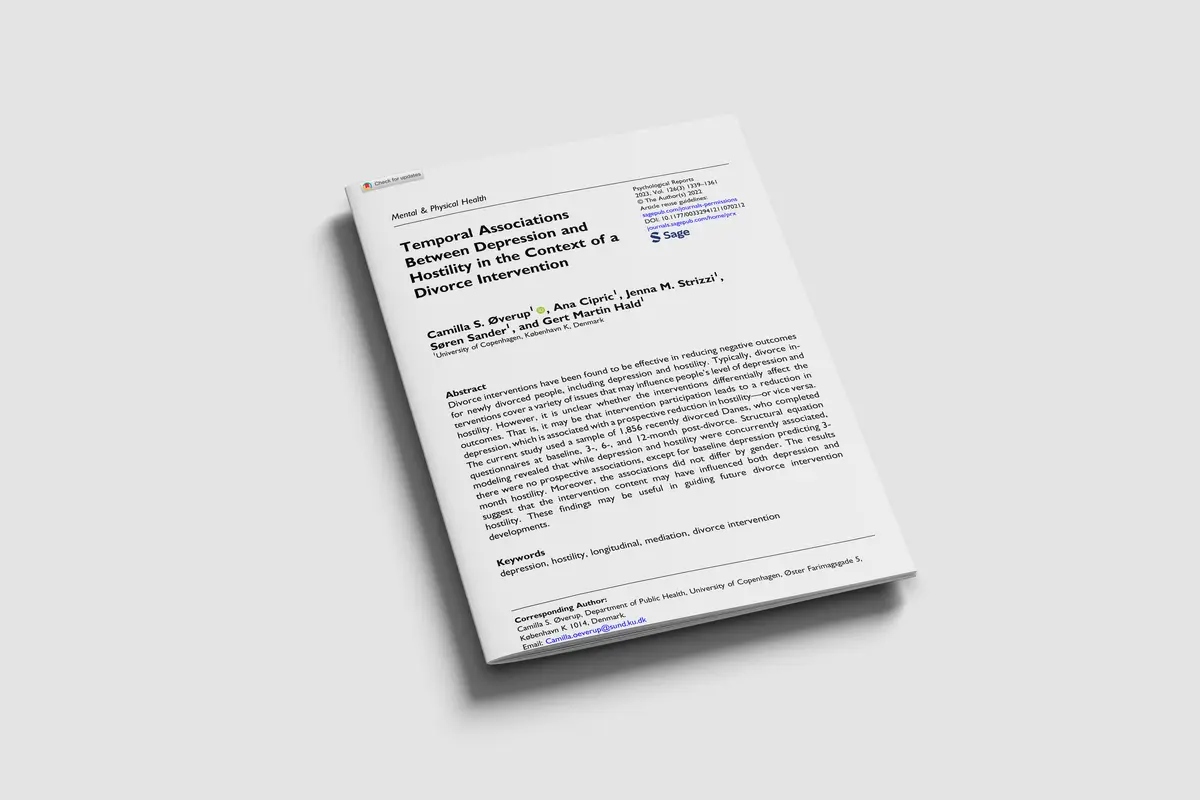
Øverup, Cipric, Strizzi, Sander & Hald (2023). Psychological Reports, 126(3), 1339–1361. DOI: 10.1177/00332941211070212 · Funded by the Carlsberg Foundation (CF16-0094).